by Zachary Cikanek, API, Nov 15, 2013
API Director of Upstream and Industry Operations Erik Milito welcomed today’s authorization by the Department of Energy for exports from the Quintana Island, Texas liquefied natural gas (LNG) facility and urged the agency to quickly process the remaining 21 applications:
“LNG exports will significantly reduce our trade deficit, grow the economy, and support thousands of U.S. jobs. The DOE has every reason to quickly approve these applications, and we’re pleased that they seem to be moving ahead. The shale revolution -- sparked by U.S. innovations in hydraulic fracturing -- has positioned America to play a leading role in the global energy trade, and we must work fast to secure a competitive position in the international market. We continue to urge Energy Secretary Moniz to oversee speedy review and approval of the remaining U.S. LNG export permit applications.”
[Read more]
Showing posts with label LNG. Show all posts
Showing posts with label LNG. Show all posts
Sunday, November 17, 2013

Wednesday, June 19, 2013
BP: US oil production growth hit record-high in 2012
by Conglin Xu, OGJ, June 12, 2013
The US recorded the largest single-year increase in oil production in 2012, according to the BP Statistical Review of World Energy. The review, released June 12 [2013], was the company’s 62nd annual report.
Backed by increasing production of unconventional oil and gas, the US recorded the highest growth in both oil and natural gas output in 2012, BP said. Meanwhile, coal consumption in the US experienced the largest decline in 2012 as it was displaced by less-expensive natural gas in electric power generation.
According to BP, world nuclear output recorded the largest annual decline in 2012. After 2011’s Fukushima accident, “higher imports of fossil fuels including [LNG] kept the lights on” in Japan. Due to higher natural gas prices in Europe, power generators substituted coal for gas—an opposite course from the US. [...]
World [primary - D.R.] energy consumption also dropped to 1.8% in 2012, down from 2.4% the previous year, BP reported. The decline was attributable to the economic slowdown as well as improved energy consumption efficiency due to high prices. As the major source of demand growth, emerging countries accounted for 56% of global consumption, up from 42% just 20 years ago.
Global oil consumption increased by 890,000 b/d, 0.9% below the historical average. OECD consumption declined by 1.3% (530,000 b/d) and non-OECD consumption grew by 3.3% (1.4 million b/d).
Global oil production climbed by 1.9 million b/d. Despite a decline in Iranian output due to international sanctions, OPEC contributed to about three quarters of the global increase. [Libyan production recovered strongly after the sharp drop in output in 2011, and Saudi Arabia, the UAE, and Qatar all produced at record levels - D.R.]. Non-OPEC production grew by 490,000 b/d [revised figure 440,000 b/d, according to BP data - D.R.] with increases in the US, Canada, Russia, and China.
BP’s review also stated that world natural gas consumption grew by 2.2%, below the historical average of 2.7%. [Read more]
(Please see BP Statistical Review of World Energy June 2013 - D.R.)
The US recorded the largest single-year increase in oil production in 2012, according to the BP Statistical Review of World Energy. The review, released June 12 [2013], was the company’s 62nd annual report.
Backed by increasing production of unconventional oil and gas, the US recorded the highest growth in both oil and natural gas output in 2012, BP said. Meanwhile, coal consumption in the US experienced the largest decline in 2012 as it was displaced by less-expensive natural gas in electric power generation.
According to BP, world nuclear output recorded the largest annual decline in 2012. After 2011’s Fukushima accident, “higher imports of fossil fuels including [LNG] kept the lights on” in Japan. Due to higher natural gas prices in Europe, power generators substituted coal for gas—an opposite course from the US. [...]
World [primary - D.R.] energy consumption also dropped to 1.8% in 2012, down from 2.4% the previous year, BP reported. The decline was attributable to the economic slowdown as well as improved energy consumption efficiency due to high prices. As the major source of demand growth, emerging countries accounted for 56% of global consumption, up from 42% just 20 years ago.
Global oil consumption increased by 890,000 b/d, 0.9% below the historical average. OECD consumption declined by 1.3% (530,000 b/d) and non-OECD consumption grew by 3.3% (1.4 million b/d).
Global oil production climbed by 1.9 million b/d. Despite a decline in Iranian output due to international sanctions, OPEC contributed to about three quarters of the global increase. [Libyan production recovered strongly after the sharp drop in output in 2011, and Saudi Arabia, the UAE, and Qatar all produced at record levels - D.R.]. Non-OPEC production grew by 490,000 b/d [revised figure 440,000 b/d, according to BP data - D.R.] with increases in the US, Canada, Russia, and China.
BP’s review also stated that world natural gas consumption grew by 2.2%, below the historical average of 2.7%. [Read more]
(Please see BP Statistical Review of World Energy June 2013 - D.R.)
Friday, August 3, 2012
East Africa Set for Major Gas, Oil Transformation
By Jacinta Moran in Cape Town; Edited by Jeremy Lovell, Platts, Jul 12, 2012
Oil and gas activity has started rolling in East Africa, as drilling activity ramps up, long-awaited deals are sealed and oil companies scramble to get a slice of what could be an energy goldmine. (see related map: East Africa oil and gas resources) [or right here below
 click on map to enlarge -- D.R.]
In Uganda, Tullow Oil has resolved a long-standing dispute with the government for the development of a number of oil-rich blocks, and the UK-listed explorer has also made Kenya's first ever major oil discovery.
Significant gas reserves have been found in Mozambique and Tanzania, where LNG facilities are now been planned. Drilling will kick off in Ethiopia later this year, while Madagascar is believed to hold significant reserves of gas and the Puntland region of Somalia is also showing positive signs. [Read more]
(Also, please see my posts "East African Oil & Gas" and "Third Tanzanian Gas Discovery for Ophir-BG. For gas reserves, please see "Wood Mackenzie: East Africa’s Yet-to-Find Reserves Hold 95 tcf of Gas," OffshoreEnergy Today.com, Aug 22, 2012---Recent discoveries and high profile M&A activity in Mozambique and Tanzania are attracting attention and Martin Kelly, Wood Mackenzie’s Head of Sub-Sahara Upstream Research, says the interest is justified: “100 tcf of gas has been discovered to date in East Africa and we estimate yet-to-find reserves could be as much as 80 tcf in Mozambique and 15 tcf in Tanzania. There is clearly plenty of gas to supply the likely commercialization route of LNG – theoretically enough to support up to 16 LNG trains. “The Rovuma basin is the most prolific in the region, and one of the hottest conventional gas plays in the world, with 85 tcf discovered so far. Globally in 2011, it yielded the third most hydrocarbons, and we expect it to top the list in 2012 if the first half of the year is anything to go by,” Kelly continues. Update: East Africa may be the new hotspot for explorers but the region will first need to invest in infrastructure to develop and transport the products for domestic and international consumption. The region's regulatory and infrastructure gaps could hinder the transition from gas exploration to production in the medium term, while governments need to be more realistic about timeframes for revenue flows, delegates heard at an industry conference in London on October 2, 2012. [...] Total now expects first commercial oil in Uganda in 2017, a year later than originally expected. The French major entered Uganda's nascent industry early this year after it and China's CNOOC took a third of Tullow's assets for $2.9 billion---please see Jacinta Moran "East Africa Faces Energy Infrastructure Issue," Platts, Oct 4, 2012 -- D.R.)
Oil and gas activity has started rolling in East Africa, as drilling activity ramps up, long-awaited deals are sealed and oil companies scramble to get a slice of what could be an energy goldmine. (see related map: East Africa oil and gas resources) [or right here below
 click on map to enlarge -- D.R.]
Significant gas reserves have been found in Mozambique and Tanzania, where LNG facilities are now been planned. Drilling will kick off in Ethiopia later this year, while Madagascar is believed to hold significant reserves of gas and the Puntland region of Somalia is also showing positive signs. [Read more]
(Also, please see my posts "East African Oil & Gas" and "Third Tanzanian Gas Discovery for Ophir-BG. For gas reserves, please see "Wood Mackenzie: East Africa’s Yet-to-Find Reserves Hold 95 tcf of Gas," OffshoreEnergy Today.com, Aug 22, 2012---Recent discoveries and high profile M&A activity in Mozambique and Tanzania are attracting attention and Martin Kelly, Wood Mackenzie’s Head of Sub-Sahara Upstream Research, says the interest is justified: “100 tcf of gas has been discovered to date in East Africa and we estimate yet-to-find reserves could be as much as 80 tcf in Mozambique and 15 tcf in Tanzania. There is clearly plenty of gas to supply the likely commercialization route of LNG – theoretically enough to support up to 16 LNG trains. “The Rovuma basin is the most prolific in the region, and one of the hottest conventional gas plays in the world, with 85 tcf discovered so far. Globally in 2011, it yielded the third most hydrocarbons, and we expect it to top the list in 2012 if the first half of the year is anything to go by,” Kelly continues. Update: East Africa may be the new hotspot for explorers but the region will first need to invest in infrastructure to develop and transport the products for domestic and international consumption. The region's regulatory and infrastructure gaps could hinder the transition from gas exploration to production in the medium term, while governments need to be more realistic about timeframes for revenue flows, delegates heard at an industry conference in London on October 2, 2012. [...] Total now expects first commercial oil in Uganda in 2017, a year later than originally expected. The French major entered Uganda's nascent industry early this year after it and China's CNOOC took a third of Tullow's assets for $2.9 billion---please see Jacinta Moran "East Africa Faces Energy Infrastructure Issue," Platts, Oct 4, 2012 -- D.R.)
Saturday, October 15, 2011
Angolan Oil Production Has Doubled Since 2003
EIA, Today in Energy, Oct 14, 2011
 Source: U.S. Energy Information Administration, Angola Country Analysis Brief & Short-Term Energy Outlook Table 3c: OPEC Crude Oil Production.Download CSV Data [Note: Presumably, crude oil production excluding condensates since the mid-2000s -- D.R.]
Angola has emerged as Africa's second largest oil producer [after Nigeria, and please see remarks below -- D.R.]; its oil production has grown 147% since 2000. Angola is the eighth largest supplier of crude oil to the United States [please see remarks below -- D.R.] and the second largest crude supplier to China, according to data for January through July 2011. Angola is still rebuilding from a 27-year civil war that ended in 2002. Security issues remain, especially in the disputed oil-rich Cabinda exclave. Border disputes have halted some oil developments.
A member of the Organization of the Petroleum Exporting Countries (OPEC), Angola has production targets ranging from 1.52 to 1.66 million barrels per day (bbl/d); however, the country is currently increasing its oil production and capacity. In 2010, Angola produced about 1.85 million bbl/d of crude oil [excluding condensates -- D.R.] and, given very low levels of domestic consumption, exported all but 50 thousand bbl/d.
Oil is crucial to the Angolan economy, accounting for over 95% of export revenues and over 75% of government revenue. In 2010, Angola exported almost 1.8 million bbl/d of crude oil; the majority of crude oil exports went to China (45%) and the United States (23%), representing 17% and 4% of those countries' total crude oil imports, respectively.
Production in 2011 is down, averaging 1.65 million bbl/d, due to temporary technical problems. Industry analysts expect Angolan production to grow beyond 1.85 million bbl/d by the end of 2011, and perhaps reach 2.5 to 3 million bbl/d of capacity by 2016, based on planned project startups.
International oil companies, including Chevron, ExxonMobil, Total, Eni, and BP, play a major role in Angola, operating most production. The Angolan government recently held a licensing round for a pre-selected group of private companies to explore and produce in the country's pre-salt offshore areas—an area believed to be of similar geological makeup to the Brazilian pre-salt.
China is a major investor in Angola and has provided several multi-billion dollar oil-backed loans to fund infrastructure development. The China Petroleum & Chemical Corporation (Sinopec) and China National Offshore Oil Corporation (CNOOC) are among the national oil companies working in Angola. Angola is now the second largest supplier of oil to China, behind Saudi Arabia.
According to EIA's recently released Angola Country Analysis Brief, Angola had 10.9 trillion cubic feet (Tcf) of natural gas reserves in 2011, up from an estimated 2 Tcf in 2007. Natural gas production in Angola is tied directly to oil production and is often vented or flared, with limited volumes consumed domestically. An Angolan liquefied natural gas (LNG) terminal, due to commence operation in 2012, will allow Angola to export its natural gas and reduce flaring. [Full story]
(Please see Aaron and David Rachovich, "Africa's Top 8 Oil Producers, 2006-2010 -- EIA." Angola was in 2009-2010/full year the seventh largest supplier of crude oil to the United States---please see our post "U.S. Crude Oil Imports from Top 15 Countries ... -- EIA." According to Oil and Gas Journal (OGJ), Angola's proved oil reserves stood at 9.5 billion bbl as of Jan 1, 2011---please see our post "World's Top 22 Proven Oil Reserves Holders, Jan 1, 2011 -- OGJ," while BP Statistical Review of World Energy, June 2011, places Angolan proved oil reserves as high as 13.5 billion bbl---please see our post "World's Top 23 Proven Oil Reserves Holders, 2007-2010 -- BP." -- D.R.)

Angola has emerged as Africa's second largest oil producer [after Nigeria, and please see remarks below -- D.R.]; its oil production has grown 147% since 2000. Angola is the eighth largest supplier of crude oil to the United States [please see remarks below -- D.R.] and the second largest crude supplier to China, according to data for January through July 2011. Angola is still rebuilding from a 27-year civil war that ended in 2002. Security issues remain, especially in the disputed oil-rich Cabinda exclave. Border disputes have halted some oil developments.
A member of the Organization of the Petroleum Exporting Countries (OPEC), Angola has production targets ranging from 1.52 to 1.66 million barrels per day (bbl/d); however, the country is currently increasing its oil production and capacity. In 2010, Angola produced about 1.85 million bbl/d of crude oil [excluding condensates -- D.R.] and, given very low levels of domestic consumption, exported all but 50 thousand bbl/d.
Oil is crucial to the Angolan economy, accounting for over 95% of export revenues and over 75% of government revenue. In 2010, Angola exported almost 1.8 million bbl/d of crude oil; the majority of crude oil exports went to China (45%) and the United States (23%), representing 17% and 4% of those countries' total crude oil imports, respectively.
Production in 2011 is down, averaging 1.65 million bbl/d, due to temporary technical problems. Industry analysts expect Angolan production to grow beyond 1.85 million bbl/d by the end of 2011, and perhaps reach 2.5 to 3 million bbl/d of capacity by 2016, based on planned project startups.
International oil companies, including Chevron, ExxonMobil, Total, Eni, and BP, play a major role in Angola, operating most production. The Angolan government recently held a licensing round for a pre-selected group of private companies to explore and produce in the country's pre-salt offshore areas—an area believed to be of similar geological makeup to the Brazilian pre-salt.
China is a major investor in Angola and has provided several multi-billion dollar oil-backed loans to fund infrastructure development. The China Petroleum & Chemical Corporation (Sinopec) and China National Offshore Oil Corporation (CNOOC) are among the national oil companies working in Angola. Angola is now the second largest supplier of oil to China, behind Saudi Arabia.
According to EIA's recently released Angola Country Analysis Brief, Angola had 10.9 trillion cubic feet (Tcf) of natural gas reserves in 2011, up from an estimated 2 Tcf in 2007. Natural gas production in Angola is tied directly to oil production and is often vented or flared, with limited volumes consumed domestically. An Angolan liquefied natural gas (LNG) terminal, due to commence operation in 2012, will allow Angola to export its natural gas and reduce flaring. [Full story]
(Please see Aaron and David Rachovich, "Africa's Top 8 Oil Producers, 2006-2010 -- EIA." Angola was in 2009-2010/full year the seventh largest supplier of crude oil to the United States---please see our post "U.S. Crude Oil Imports from Top 15 Countries ... -- EIA." According to Oil and Gas Journal (OGJ), Angola's proved oil reserves stood at 9.5 billion bbl as of Jan 1, 2011---please see our post "World's Top 22 Proven Oil Reserves Holders, Jan 1, 2011 -- OGJ," while BP Statistical Review of World Energy, June 2011, places Angolan proved oil reserves as high as 13.5 billion bbl---please see our post "World's Top 23 Proven Oil Reserves Holders, 2007-2010 -- BP." -- D.R.)
Tuesday, October 11, 2011
United Kingdom Natural Gas and Oil Production Continues Decade-Long Decline
EIA, Today in Energy, Sept 21, 2011

The United Kingdom (U.K.) is the largest producer of oil and second-largest producer of natural gas in the European Union [after the Netherlands -- D.R.]. Due to steadily declining production since the early 2000s, the U.K. became a net importer of natural gas and oil in 2004 and 2005, respectively.
In 2010, the U.K. produced 1.4 million barrels per day (bbl/d) of oil and consumed 1.6 million bbl/d. [Please see remarks below -- D.R.]. While consumption remained relatively constant throughout the last decade, 2010 production declined 7% from 2009. Further declines are expected: the U.S. Energy Information Administration's Short-Term Energy Outlook predicts the U.K.'s production will fall to 1.2 million bbl/d in 2012. Despite decreasing production, the U.K. remains one of the European Union's leading petroleum exporters; in 2010, the U.K. exported 832,000 bbl/d, more than half of its total production.

In 2010, U.K. natural gas production was 2.0 trillion cubic feet, a 5% drop from 2009, and the lowest level since 1992. Natural gas consumption rose 7% in 2010. To offset its declining natural gas production in the North Sea, the U.K. is importing more liquefied natural gas (LNG). Deliveries of LNG to the U.K. were up 0.86 billion cubic feet per day, or 54%, during the first nine months of 2011 compared to the same period in 2010.
Because discoveries of new oil and natural gas reserves have not outpaced the maturation of existing oil and natural gas fields, production from both has declined. The U.K.'s increasing reliance on imported natural gas and oil has spurred the government to develop energy policies to focus on enhanced oil and gas recovery, as well as increased cooperation with Norway—U.K.'s largest oil supplier. The U.K. has also invested heavily in renewable energy; according to the U.K. Department of Energy and Climate Change, the U.K. has the largest offshore wind resource in the world.
EIA's United Kingdom Country Analysis Brief features additional analysis of these trends, along with a broad discussion of the U.K.'s energy sector. [Full story]
(Note that oil production refers to the total oil supply, including the production of crude oil, natural gas plant liquids, and other liquids, and refinery processing gain. While oil consumption refers to the total petroleum consumption, including internal consumption, refinery fuel and loss, and bunkering. UK crude oil production, including lease condensate, dropped to 1.2 million bbl/d in 2010, from about 2.7 million bbl/d in 1999. According to Oil and Gas Journal (OGJ), UK's proved oil reserves stood at 2.858 billion bbl as of Jan 1, 2011, a decrease of 7.4% when compared with the Jan 1, 2010. Also, according to OGJ, the UK had 9,040 billion cubic feet (bcf) of proven natural gas reserves as of Jan 1, 2011, a 12% decline from the previous year. -- D.R.)

Source: U.S. Energy Information Administration, United Kingdom Country Analysis Brief.Download CSV Data
The United Kingdom (U.K.) is the largest producer of oil and second-largest producer of natural gas in the European Union [after the Netherlands -- D.R.]. Due to steadily declining production since the early 2000s, the U.K. became a net importer of natural gas and oil in 2004 and 2005, respectively.
In 2010, the U.K. produced 1.4 million barrels per day (bbl/d) of oil and consumed 1.6 million bbl/d. [Please see remarks below -- D.R.]. While consumption remained relatively constant throughout the last decade, 2010 production declined 7% from 2009. Further declines are expected: the U.S. Energy Information Administration's Short-Term Energy Outlook predicts the U.K.'s production will fall to 1.2 million bbl/d in 2012. Despite decreasing production, the U.K. remains one of the European Union's leading petroleum exporters; in 2010, the U.K. exported 832,000 bbl/d, more than half of its total production.

Source: U.S. Energy Information Administration, United Kingdom Country Analysis Brief.Download CSV Data
In 2010, U.K. natural gas production was 2.0 trillion cubic feet, a 5% drop from 2009, and the lowest level since 1992. Natural gas consumption rose 7% in 2010. To offset its declining natural gas production in the North Sea, the U.K. is importing more liquefied natural gas (LNG). Deliveries of LNG to the U.K. were up 0.86 billion cubic feet per day, or 54%, during the first nine months of 2011 compared to the same period in 2010.
Because discoveries of new oil and natural gas reserves have not outpaced the maturation of existing oil and natural gas fields, production from both has declined. The U.K.'s increasing reliance on imported natural gas and oil has spurred the government to develop energy policies to focus on enhanced oil and gas recovery, as well as increased cooperation with Norway—U.K.'s largest oil supplier. The U.K. has also invested heavily in renewable energy; according to the U.K. Department of Energy and Climate Change, the U.K. has the largest offshore wind resource in the world.
EIA's United Kingdom Country Analysis Brief features additional analysis of these trends, along with a broad discussion of the U.K.'s energy sector. [Full story]
(Note that oil production refers to the total oil supply, including the production of crude oil, natural gas plant liquids, and other liquids, and refinery processing gain. While oil consumption refers to the total petroleum consumption, including internal consumption, refinery fuel and loss, and bunkering. UK crude oil production, including lease condensate, dropped to 1.2 million bbl/d in 2010, from about 2.7 million bbl/d in 1999. According to Oil and Gas Journal (OGJ), UK's proved oil reserves stood at 2.858 billion bbl as of Jan 1, 2011, a decrease of 7.4% when compared with the Jan 1, 2010. Also, according to OGJ, the UK had 9,040 billion cubic feet (bcf) of proven natural gas reserves as of Jan 1, 2011, a 12% decline from the previous year. -- D.R.)
Saturday, August 6, 2011

Monday, June 6, 2011
Indonesia to Fall Short of 2011 Oil Output Target - BPMigas
Platts, May 25, 2011
Indonesia's crude and condensate production this year will likely average between 933,000 b/d and 945,000 b/d, below its target of 970,000 b/d as a result of unplanned shutdowns, the chairman of upstream regulator BPMigas said Tuesday [please see remarks below -- D.R.].
"The average production this year is expected [to] reach 933,000 b/d in minimum or 945,000 b/d in maximum," R. Priyono said in a parliamentary hearing. [...]
Gas production is now expected to average 7.808 Bcf/d, exceeding its target this year of 7.769 Bcf/d, Priyono said. [...]
The country's oil and gas revenue in 2011 is now seen reaching $31.088 billion, well above the target of $26.554 billion, as crude and gas prices are expected to be higher than previously forecast. [...]
Indonesia's crude and condensate output has been steadily sliding for at least the last decade [also, please see my post "Top 8 Oil Producers in Asia & Oceania, 2006-2010," and please see remarks below -- D.R.] because of natural declines at aging fields. But the government hopes to be able to produce 1 million b/d of crude and condensate by 2013.
The country failed to achieve its 2010 crude target of 965,000 b/d, pumping only 947,000 b/d. However the country exceeded last year's gas production by 17.4% to 8.88 Bcf/d from a target of 7.56 Bcf/d [sic; target - 7.758 Bcf/d? -- D.R]. [Read full]
(According to BPMigas data, Indonesia's oil production was only 916,000 barrels per day as of the end of April 2011---please see The Jakarta Post, June 3, 2011, here. Indonesia's crude oil production has been declining since 1997, due to the maturation of the country's largest oil fields and failure to develop new, comparable resources. In 1996 it produced 1,547,486 barrels of crude oil including lease condensate per day---please see EIA's data, here. Indonesia was a member of the Organization of Petroleum Exporting Countries/OPEC from 1962 to 2008. In 2004, the country became a net oil importer and in January 2009, suspended its OPEC membership. BPMigas and the Indonesian government have introduced policies aimed at increasing investment in the country's upstream sector - in particular via investment incentives and improving the flexibility of the production sharing contracts/PSC bidding process---read more U.S. EIA, Indonesia Country Analysis Brief, May 2011, here. According to the Oil & Gas Journal's Jan 1, 2011 estimate, Indonesia's proved oil reserves stand at 3.99 billion barrels. Indonesia was the third-largest exporter of liquefied natural gas/LNG in the world in 2009, following only Qatar and Malaysia. And in 2010, it was Japan's third-largest LNG supplier, after Malaysia and Australia---please see charts, here -- D.R.)
Indonesia's crude and condensate production this year will likely average between 933,000 b/d and 945,000 b/d, below its target of 970,000 b/d as a result of unplanned shutdowns, the chairman of upstream regulator BPMigas said Tuesday [please see remarks below -- D.R.].
"The average production this year is expected [to] reach 933,000 b/d in minimum or 945,000 b/d in maximum," R. Priyono said in a parliamentary hearing. [...]
Gas production is now expected to average 7.808 Bcf/d, exceeding its target this year of 7.769 Bcf/d, Priyono said. [...]
The country's oil and gas revenue in 2011 is now seen reaching $31.088 billion, well above the target of $26.554 billion, as crude and gas prices are expected to be higher than previously forecast. [...]
Indonesia's crude and condensate output has been steadily sliding for at least the last decade [also, please see my post "Top 8 Oil Producers in Asia & Oceania, 2006-2010," and please see remarks below -- D.R.] because of natural declines at aging fields. But the government hopes to be able to produce 1 million b/d of crude and condensate by 2013.
The country failed to achieve its 2010 crude target of 965,000 b/d, pumping only 947,000 b/d. However the country exceeded last year's gas production by 17.4% to 8.88 Bcf/d from a target of 7.56 Bcf/d [sic; target - 7.758 Bcf/d? -- D.R]. [Read full]
(According to BPMigas data, Indonesia's oil production was only 916,000 barrels per day as of the end of April 2011---please see The Jakarta Post, June 3, 2011, here. Indonesia's crude oil production has been declining since 1997, due to the maturation of the country's largest oil fields and failure to develop new, comparable resources. In 1996 it produced 1,547,486 barrels of crude oil including lease condensate per day---please see EIA's data, here. Indonesia was a member of the Organization of Petroleum Exporting Countries/OPEC from 1962 to 2008. In 2004, the country became a net oil importer and in January 2009, suspended its OPEC membership. BPMigas and the Indonesian government have introduced policies aimed at increasing investment in the country's upstream sector - in particular via investment incentives and improving the flexibility of the production sharing contracts/PSC bidding process---read more U.S. EIA, Indonesia Country Analysis Brief, May 2011, here. According to the Oil & Gas Journal's Jan 1, 2011 estimate, Indonesia's proved oil reserves stand at 3.99 billion barrels. Indonesia was the third-largest exporter of liquefied natural gas/LNG in the world in 2009, following only Qatar and Malaysia. And in 2010, it was Japan's third-largest LNG supplier, after Malaysia and Australia---please see charts, here -- D.R.)
Saturday, June 4, 2011
Shale Gas Revolution -- Shale Can Support [U.S.] LNG Exports: Chesapeake
Platts, May 26, 2011
Shale gas pioneer Chesapeake Energy is confident unconventional gas plays would support proposed US LNG export projects, and believes the US could produce more than 90 Bcf/d of gas at prices are "not that high," a company executive said Wednesday.
"We have a very strong mandate from our CEO to export (LNG from the US)," Bill Wince, vice president of transportation and business development at Chesapeake, said during a panel presentation at CWC’s Americas LNG Summit here. [...]
Chesapeake last year signed a preliminary agreement to supply as much as 500,000 Mcf/d to Cheniere Energy’s proposed LNG export project in Louisiana, which aims to start exporting in 2015. Chesapeake is also talking to the proposed LNG export project in Freeport, Texas, Wince told Platts on the sidelines of the conference, declining to comment on the relative merits of the two proposals.
Current US production stands at 64-65 Bcf/d, Wince said during his presentation. [Also, please see my post "Natural Gas Production/Consumption Retrospective 2010." -- D.R] [...]
The Marcellus play needs a price of only $2.45/Mcf to provide a 10% rate of return, according to a slide he [Wince] presented. The Haynesville play needs a $4.25/Mcf price to provide the same rate of return, while the Fayetteville play needs a price of $4.70/Mcf and the Barnett play needs a price of $5.05/Mcf, the slide showed. [...]
Current production from four major shale areas is 15 Bcf/d, he said, adding that the advent of low US gas prices in recent years coincided with shale production gains. [...]
US shale production is greatly reducing basis differentials in the US market, which historically have been caused by transportation costs between producing and consuming regions, Wince said.
"We crush the basis,” he said about Chesapeake, which ranks as the country’s second-largest gas producer [after ExxonMobil -- D.R.], producing 2.7 Bcf/d in the first quarter. [...]
A significant amount of LNG import infrastructure was built last decade before the shale boom was well understood, as industry players expected LNG to make up for projected decreases in domestic gas production.
Shale gas crowds out Yemen LNG
Yemen LNG was primarily designed to sell significant LNG volumes to the US, but "the market disappeared,” Jean-Pierre Cave, head of commercial and shipping at Yemen LNG, said at the conference. [...]
Based on last week’s ruling [May 20] by the US Department of Energy authorizing Cheniere to export US-produced LNG from Sabine Pass [please see my post "Cheniere Gets OK to Ship LNG Overseas," -- D.R.], Bill Cooper, president of the Center for LNG industry group, said he expects other proposed US export projects to get similar approval. [...] [Read full]
(According to the U.S. Energy Information Administration/EIA, in the past 10 years, U.S. shale gas production has increased more than 12-fold from 0.39 trillion cubic feet/tcf in 2000 to 4.87 tcf in 2010. In 2010, U.S. shale gas production constituted 23 percent of total U.S. natural gas production---please see here. In 2009, the U.S., with its big shale gas resources, even surpassed Russia as the world's largest natural gas producer---please see EIA's data, here. -- D.R.)
Shale gas pioneer Chesapeake Energy is confident unconventional gas plays would support proposed US LNG export projects, and believes the US could produce more than 90 Bcf/d of gas at prices are "not that high," a company executive said Wednesday.
"We have a very strong mandate from our CEO to export (LNG from the US)," Bill Wince, vice president of transportation and business development at Chesapeake, said during a panel presentation at CWC’s Americas LNG Summit here. [...]
Chesapeake last year signed a preliminary agreement to supply as much as 500,000 Mcf/d to Cheniere Energy’s proposed LNG export project in Louisiana, which aims to start exporting in 2015. Chesapeake is also talking to the proposed LNG export project in Freeport, Texas, Wince told Platts on the sidelines of the conference, declining to comment on the relative merits of the two proposals.
Current US production stands at 64-65 Bcf/d, Wince said during his presentation. [Also, please see my post "Natural Gas Production/Consumption Retrospective 2010." -- D.R] [...]
The Marcellus play needs a price of only $2.45/Mcf to provide a 10% rate of return, according to a slide he [Wince] presented. The Haynesville play needs a $4.25/Mcf price to provide the same rate of return, while the Fayetteville play needs a price of $4.70/Mcf and the Barnett play needs a price of $5.05/Mcf, the slide showed. [...]
Current production from four major shale areas is 15 Bcf/d, he said, adding that the advent of low US gas prices in recent years coincided with shale production gains. [...]
US shale production is greatly reducing basis differentials in the US market, which historically have been caused by transportation costs between producing and consuming regions, Wince said.
"We crush the basis,” he said about Chesapeake, which ranks as the country’s second-largest gas producer [after ExxonMobil -- D.R.], producing 2.7 Bcf/d in the first quarter. [...]
A significant amount of LNG import infrastructure was built last decade before the shale boom was well understood, as industry players expected LNG to make up for projected decreases in domestic gas production.
Shale gas crowds out Yemen LNG
Yemen LNG was primarily designed to sell significant LNG volumes to the US, but "the market disappeared,” Jean-Pierre Cave, head of commercial and shipping at Yemen LNG, said at the conference. [...]
Based on last week’s ruling [May 20] by the US Department of Energy authorizing Cheniere to export US-produced LNG from Sabine Pass [please see my post "Cheniere Gets OK to Ship LNG Overseas," -- D.R.], Bill Cooper, president of the Center for LNG industry group, said he expects other proposed US export projects to get similar approval. [...] [Read full]
(According to the U.S. Energy Information Administration/EIA, in the past 10 years, U.S. shale gas production has increased more than 12-fold from 0.39 trillion cubic feet/tcf in 2000 to 4.87 tcf in 2010. In 2010, U.S. shale gas production constituted 23 percent of total U.S. natural gas production---please see here. In 2009, the U.S., with its big shale gas resources, even surpassed Russia as the world's largest natural gas producer---please see EIA's data, here. -- D.R.)
Wednesday, May 25, 2011
Cheniere Gets OK to Ship [LNG] Overseas
Upstream Online, May 20, 2011
Cheniere Energy received approval from the Department of Energy to export US natural gas overseas, the first such authorization in over forty years, the company said today.
Assuming Cheniere is granted a subsequent license from US power regulators to build its liquefaction plant in Louisiana, it may become the first company to begin shipping LNG abroad since the discovery of vast shale reserves in recent years upended the US market, flooding it with decades' worth of supply.
Cheniere has the authorization to export up to 803 billion cubic feet of natural gas per year to major LNG importers across the globe [...] in the form of liquefied natural gas [...] [Actually, Cheniere now has authorization to export domestically produced natural gas from the Sabine Pass LNG terminal as LNG to any country that has, or in the future develops, the capacity to import LNG and with which trade is permissible -- D.R.]
The Houston-based company already had approval [as of Sept 2010] to export natural gas [as LNG] to countries with which the United States had a free-trade agreement [such as Mexico, Canada, Chile and Singapore ...].
Friday's [May 20] move opens up the export to all major [and minor] LNG importers.
"With the unprecedented growth in unconventional reserves, supply of natural gas (in the United States) continues to outpace demand dramatically," said Cheniere chief executive Charif Souki.
"The US has an opportunity to become a significant supplier in the global energy markets," he added.
The first and only US LNG export plant was built in Alaska 40 years ago [the Kenai LNG export plant began operating in 1969 -- D.R.], but is now in the process of shutting down because it is no longer competitive with newer suppliers in Asia.
Cheniere announced plans last year to build a natural gas liquefaction plant at Sabine Pass in Louisiana, which it expects will come online in 2015 on the site of its existing LNG import terminal.
The approval is subject to the Federal Energy Regulatory Commission giving approval to build the export plant. [Read full]
(Following the conditional authorization of LNG exports from the Sabine Pass terminal, Lithuania's Deputy Foreign Minister Egidijus Meilūnas discussed the implications of the export project with the U.S. State Department. Meilūnas observed that U.S. LNG exports could help lower Lithuanian natural gas prices---please see The Baltic Course, May 24, 2011. "Exporting LNG to Lithuania will allow one of our allies to diversify its natural gas supply, increase its energy security and strengthen its economy. Cheniere is happy to fill this important role in the global energy markets," said Charif Souki, Chairman, President and CEO of Cheniere Energy, Inc.---please see here. For Lithuania's natural gas consumption in 2010, please see my post "Eurogas: EU 27 Gas Consumption Rises 7.2% in 2010," including remarks, here. Separately, for the U.S. shale gas production and reserves, please see my post "[United States:] Natural Gas Production/Consumption Retrospective 2010," including remarks, here. -- D.R.)
Cheniere Energy received approval from the Department of Energy to export US natural gas overseas, the first such authorization in over forty years, the company said today.
Assuming Cheniere is granted a subsequent license from US power regulators to build its liquefaction plant in Louisiana, it may become the first company to begin shipping LNG abroad since the discovery of vast shale reserves in recent years upended the US market, flooding it with decades' worth of supply.
Cheniere has the authorization to export up to 803 billion cubic feet of natural gas per year to major LNG importers across the globe [...] in the form of liquefied natural gas [...] [Actually, Cheniere now has authorization to export domestically produced natural gas from the Sabine Pass LNG terminal as LNG to any country that has, or in the future develops, the capacity to import LNG and with which trade is permissible -- D.R.]
The Houston-based company already had approval [as of Sept 2010] to export natural gas [as LNG] to countries with which the United States had a free-trade agreement [such as Mexico, Canada, Chile and Singapore ...].
Friday's [May 20] move opens up the export to all major [and minor] LNG importers.
"With the unprecedented growth in unconventional reserves, supply of natural gas (in the United States) continues to outpace demand dramatically," said Cheniere chief executive Charif Souki.
"The US has an opportunity to become a significant supplier in the global energy markets," he added.
The first and only US LNG export plant was built in Alaska 40 years ago [the Kenai LNG export plant began operating in 1969 -- D.R.], but is now in the process of shutting down because it is no longer competitive with newer suppliers in Asia.
Cheniere announced plans last year to build a natural gas liquefaction plant at Sabine Pass in Louisiana, which it expects will come online in 2015 on the site of its existing LNG import terminal.
The approval is subject to the Federal Energy Regulatory Commission giving approval to build the export plant. [Read full]
(Following the conditional authorization of LNG exports from the Sabine Pass terminal, Lithuania's Deputy Foreign Minister Egidijus Meilūnas discussed the implications of the export project with the U.S. State Department. Meilūnas observed that U.S. LNG exports could help lower Lithuanian natural gas prices---please see The Baltic Course, May 24, 2011. "Exporting LNG to Lithuania will allow one of our allies to diversify its natural gas supply, increase its energy security and strengthen its economy. Cheniere is happy to fill this important role in the global energy markets," said Charif Souki, Chairman, President and CEO of Cheniere Energy, Inc.---please see here. For Lithuania's natural gas consumption in 2010, please see my post "Eurogas: EU 27 Gas Consumption Rises 7.2% in 2010," including remarks, here. Separately, for the U.S. shale gas production and reserves, please see my post "[United States:] Natural Gas Production/Consumption Retrospective 2010," including remarks, here. -- D.R.)
Saturday, May 14, 2011
China Plans to Exploit its Shale Gas Resources
The Institute for Energy Research (IER), Apr 27, 2011
“America’s shale gas production alone has exceeded that of total Chinese gas output. That gives us a lot of confidence,” said Zhang Dawei, deputy director of the Strategic Research Center for Oil and Gas in the Ministry of Land and Resources [please see remarks below -- D.R.].
China is looking at the production and resources of shale gas in the United States and is planning to emulate them. China’s technically recoverable resources of shale gas are estimated to be about 50 percent higher than those in the United States, which ranks second to China in a recent assessment of shale gas resources in 32 countries [also, please see my post/table "Estimated Shale Gas Technically Recoverable Resources for Select Basins in 32 Countries -- EIA," here -- D.R.]. In November 2009, during a state visit to Beijing, President Obama signed a cooperation pact with China that provides for U.S. expertise in drilling for shale gas. [...] China’s goal is to have about a fifth of its natural gas production come from unconventional gas, mainly shale gas, by 2030.
China’s Natural Gas Production and Consumption
In 2009, China produced 2,929 billion cubic feet of natural gas and consumed 3,075 billion cubic feet, importing 146 billion cubic feet. The country relies on natural gas for only 3 percent of its energy consumption, getting more than 70 percent of its energy from coal, followed by 19 percent from oil and 6 percent from hydropower [in 2008]. The government is planning to increase consumption of natural gas to a 10-percent share by 2030, and will need to continue importing gas through liquefied natural gas facilities and pipelines from neighboring countries. The [U.S.] Energy Information Administration projects that gas demand in China will more than triple by 2035, growing at 5 percent a year.
China’s government is looking to foreign investors to help develop production of its unconventional gas resources—coal bed methane and shale gas. China’s technically recoverable resources of shale gas are estimated to be 1,275 trillion cubic feet and its technically recoverable resources of coal bed methane are estimated at 350 trillion cubic feet. According to the Ministry of Land [and] Resources, China’s goals regarding shale gas are to discover 35 trillion cubic feet of recoverable shale gas reserves, build 500 to 1,000 billion cubic feet per year of production capacity and produce 8 to 12 percent of China’s total natural gas from shale gas by 2020.
Shale gas is one of China’s top targets for technological breakthroughs in its five year plan for 2011-2015. China’s Ministry of Land and Resources intended to hold its first auction of shale gas blocks in the first quarter of this year [it is already overdue -- D.R.], delaying it from November of last year. The auction is for eight exploration blocks in four provinces covering 18,000 square kilometers [please see update below -- D.R.]. [CNPC's listed arm,] PetroChina, which produces about 80 percent of China’s total gas output and is the world’s second-most valuable energy company, completed its first [horizontal] shale gas well in the Sichuan province last month [March 2011]. In February, PetroChina announced it would buy a $5.4 billion stake in Calgary-based Encana Corp’s shale gas assets. A China National Petroleum Corporation executive indicated, “We don’t care much about whether the market believes it’s a good or bad price. The top priority is gaining access to a resource and mature technology. Price is only a secondary consideration.” [Also, please see remarks below -- D.R.] [...]
Six months after President Obama’s visit in 2009, China and the United States set up a task force and agreed to jointly conduct a shale gas project, assessing an aging oil basin in China that was not very fruitful. According to industry officials, the U.S. government and companies have invited Chinese geologists for technical workshops and field trips, but Chinese firms are less interested about sharing technical information, or opening up new blocks for resource studies.
As of the end of 2009, China is estimated to have almost 21,000 miles of natural gas pipelines and is expanding at a rate of 6 percent per year. The Chinese government plans to construct 14,400 miles of new pipelines between 2009 and 2015. The West-East Gas Pipeline, which was commissioned in 2004, is China’s largest natural gas pipeline at 2,500 miles, linking major natural gas supply bases in western China with markets in the east. The pipeline’s annual capacity is 424 billion cubic feet and there are plans to increase it to 600 billion cubic feet. Four additional west-to-east pipelines are also planned with the second one to be completed in 2012.
China’s first import natural gas pipeline, the Central Asian Gas Pipeline, began operations in December 2009, carrying natural gas imports from Turkmenistan, Uzbekistan, and Kazakhstan. The pipeline spans 1,130 miles and [had an initial] capacity of 200 billion cubic feet per year with plans to increase gas supply to 1.4 trillion cubic feet per year. China has signed agreements with Uzbekistan, Kazakhstan, Russia and Myanmar for gas supplies and additional pipeline construction in the future.
China imported its first shipment of liquefied natural gas in the summer of 2006 and imported 730 million cubic feet per day in 2009 and 1,120 million cubic feet per day in the first half of 2010. China has three regasification terminals, four under construction, and others in the approval process. China receives its liquefied natural gas from Australia, Indonesia, Malaysia, Qatar [and Russia -- D.R]. Because international liquefied natural gas prices are higher than domestic gas since their contracts are indexed to oil prices, competition may be greater from domestic gas, particularly shale gas, and neighboring sources in the future. For China to develop its shale gas resources, its natural gas pipeline system, which is about a tenth of the size of the system in the United States, would need to be significantly expanded, requiring billions of dollars. [...]
Conclusion
China has found another avenue for increasing its much needed energy supplies—shale gas. China is estimated to have more technically recoverable shale gas resources than any other country in the world. And, its people are very good at learning from and imitating experts around the world in extracting resources. Here again China is oblivious to environmental issues as it is in its use of coal for over 70 percent of its energy and its mining of rare earth minerals used in making certain renewable technologies and in weapon systems, where China dominates the global market.
For the United States, the country with the second largest technically recoverable shale gas resources, environmental concerns are at issue with demonstrations in Texas, New York, and Pennsylvania; public forums sponsored by the Environmental Protection Agency; and the threat of more studies to discredit the strides that hydraulic fracturing and horizontal drilling have made to provide reasonably priced natural gas. While the United States has the technical expertise to develop its shale gas resources, it is challenged by those who want the American public to pay high energy prices. China, on the other hand, wants to provide a better standard of living for its people and is developing any resource that will pave the way. [Read more]
(In 2009, U.S. shale gas production amounted to 3.11 trillion cubic feet/tcf vis-à-vis total Chinese dry natural gas output of 2.93 tcf. In 2010, U.S. shale gas production jumped to 4.87 tcf, constituting 23 percent of total U.S. natural gas production, compared with 0.39 tcf in 2000. Сhina's natural gas production rose to 3.3 tcf in 2010, compared with 0.96 tcf in 2000. Separately, China's third-largest oil company and the country's largest offshore oil and gas producer China National Offshore Oil Corporation/CNOOC struck two deals with leading U.S. shale gas player Chesapeake in October 2010 and January 2011, giving it access to drilling leases in Texas, Wyoming and Colorado. "Chesapeake has accumulated abundant experience in drilling and completion in various U.S. shale plays," CNOOC said in a statement emailed to Reuters. "The techniques and experiences we learn from the U.S. shale projects will benefit our potential participation in other areas in the future." UPDATE: Four blocks were offered in the first tender issued June 27, 2011, all located in the Sichuan basin. The blocks in the tender are mostly in the southwestern Chongqing municipality and Guizhou province and cover an area of 11,000 square kilometers, smaller than an earlier announced plan to offer eight blocks with an area of 18,000 sq km. Only Chinese state-owned companies were invited to bid: PetroChina, Sinopec, CNOOC, Shaanxi Yanchang Petroleum, CUCBM and Henan Provincial Coal Seam Gas. China has awarded two out of four shale gas blocks offered in its auction of the unconventional gas resource to China Petroleum & Chemical Corp., i.e. Sinopec, and Henan provincial coal seam gas company, a Chinese government official said Wednesday July 6, 2011. "Both blocks covering about 2,000 square kilometers [each - D.R.] are in the Chongqing area. The contracts will be signed shortly," an official with the Ministry of Land and Resources said. Sinopec won the Nanchuan block and Henan Provincial Coal Seam Gas was awarded the Xiushan block---please see Exhibit 2 or map from the Bernstein Research, July 7, 2011. A second round will take place later this year. -- D.R.)
“America’s shale gas production alone has exceeded that of total Chinese gas output. That gives us a lot of confidence,” said Zhang Dawei, deputy director of the Strategic Research Center for Oil and Gas in the Ministry of Land and Resources [please see remarks below -- D.R.].
China is looking at the production and resources of shale gas in the United States and is planning to emulate them. China’s technically recoverable resources of shale gas are estimated to be about 50 percent higher than those in the United States, which ranks second to China in a recent assessment of shale gas resources in 32 countries [also, please see my post/table "Estimated Shale Gas Technically Recoverable Resources for Select Basins in 32 Countries -- EIA," here -- D.R.]. In November 2009, during a state visit to Beijing, President Obama signed a cooperation pact with China that provides for U.S. expertise in drilling for shale gas. [...] China’s goal is to have about a fifth of its natural gas production come from unconventional gas, mainly shale gas, by 2030.
China’s Natural Gas Production and Consumption
In 2009, China produced 2,929 billion cubic feet of natural gas and consumed 3,075 billion cubic feet, importing 146 billion cubic feet. The country relies on natural gas for only 3 percent of its energy consumption, getting more than 70 percent of its energy from coal, followed by 19 percent from oil and 6 percent from hydropower [in 2008]. The government is planning to increase consumption of natural gas to a 10-percent share by 2030, and will need to continue importing gas through liquefied natural gas facilities and pipelines from neighboring countries. The [U.S.] Energy Information Administration projects that gas demand in China will more than triple by 2035, growing at 5 percent a year.
China’s government is looking to foreign investors to help develop production of its unconventional gas resources—coal bed methane and shale gas. China’s technically recoverable resources of shale gas are estimated to be 1,275 trillion cubic feet and its technically recoverable resources of coal bed methane are estimated at 350 trillion cubic feet. According to the Ministry of Land [and] Resources, China’s goals regarding shale gas are to discover 35 trillion cubic feet of recoverable shale gas reserves, build 500 to 1,000 billion cubic feet per year of production capacity and produce 8 to 12 percent of China’s total natural gas from shale gas by 2020.
Shale gas is one of China’s top targets for technological breakthroughs in its five year plan for 2011-2015. China’s Ministry of Land and Resources intended to hold its first auction of shale gas blocks in the first quarter of this year [it is already overdue -- D.R.], delaying it from November of last year. The auction is for eight exploration blocks in four provinces covering 18,000 square kilometers [please see update below -- D.R.]. [CNPC's listed arm,] PetroChina, which produces about 80 percent of China’s total gas output and is the world’s second-most valuable energy company, completed its first [horizontal] shale gas well in the Sichuan province last month [March 2011]. In February, PetroChina announced it would buy a $5.4 billion stake in Calgary-based Encana Corp’s shale gas assets. A China National Petroleum Corporation executive indicated, “We don’t care much about whether the market believes it’s a good or bad price. The top priority is gaining access to a resource and mature technology. Price is only a secondary consideration.” [Also, please see remarks below -- D.R.] [...]
Six months after President Obama’s visit in 2009, China and the United States set up a task force and agreed to jointly conduct a shale gas project, assessing an aging oil basin in China that was not very fruitful. According to industry officials, the U.S. government and companies have invited Chinese geologists for technical workshops and field trips, but Chinese firms are less interested about sharing technical information, or opening up new blocks for resource studies.
As of the end of 2009, China is estimated to have almost 21,000 miles of natural gas pipelines and is expanding at a rate of 6 percent per year. The Chinese government plans to construct 14,400 miles of new pipelines between 2009 and 2015. The West-East Gas Pipeline, which was commissioned in 2004, is China’s largest natural gas pipeline at 2,500 miles, linking major natural gas supply bases in western China with markets in the east. The pipeline’s annual capacity is 424 billion cubic feet and there are plans to increase it to 600 billion cubic feet. Four additional west-to-east pipelines are also planned with the second one to be completed in 2012.
China’s first import natural gas pipeline, the Central Asian Gas Pipeline, began operations in December 2009, carrying natural gas imports from Turkmenistan, Uzbekistan, and Kazakhstan. The pipeline spans 1,130 miles and [had an initial] capacity of 200 billion cubic feet per year with plans to increase gas supply to 1.4 trillion cubic feet per year. China has signed agreements with Uzbekistan, Kazakhstan, Russia and Myanmar for gas supplies and additional pipeline construction in the future.
China imported its first shipment of liquefied natural gas in the summer of 2006 and imported 730 million cubic feet per day in 2009 and 1,120 million cubic feet per day in the first half of 2010. China has three regasification terminals, four under construction, and others in the approval process. China receives its liquefied natural gas from Australia, Indonesia, Malaysia, Qatar [and Russia -- D.R]. Because international liquefied natural gas prices are higher than domestic gas since their contracts are indexed to oil prices, competition may be greater from domestic gas, particularly shale gas, and neighboring sources in the future. For China to develop its shale gas resources, its natural gas pipeline system, which is about a tenth of the size of the system in the United States, would need to be significantly expanded, requiring billions of dollars. [...]
Conclusion
China has found another avenue for increasing its much needed energy supplies—shale gas. China is estimated to have more technically recoverable shale gas resources than any other country in the world. And, its people are very good at learning from and imitating experts around the world in extracting resources. Here again China is oblivious to environmental issues as it is in its use of coal for over 70 percent of its energy and its mining of rare earth minerals used in making certain renewable technologies and in weapon systems, where China dominates the global market.
For the United States, the country with the second largest technically recoverable shale gas resources, environmental concerns are at issue with demonstrations in Texas, New York, and Pennsylvania; public forums sponsored by the Environmental Protection Agency; and the threat of more studies to discredit the strides that hydraulic fracturing and horizontal drilling have made to provide reasonably priced natural gas. While the United States has the technical expertise to develop its shale gas resources, it is challenged by those who want the American public to pay high energy prices. China, on the other hand, wants to provide a better standard of living for its people and is developing any resource that will pave the way. [Read more]
(In 2009, U.S. shale gas production amounted to 3.11 trillion cubic feet/tcf vis-à-vis total Chinese dry natural gas output of 2.93 tcf. In 2010, U.S. shale gas production jumped to 4.87 tcf, constituting 23 percent of total U.S. natural gas production, compared with 0.39 tcf in 2000. Сhina's natural gas production rose to 3.3 tcf in 2010, compared with 0.96 tcf in 2000. Separately, China's third-largest oil company and the country's largest offshore oil and gas producer China National Offshore Oil Corporation/CNOOC struck two deals with leading U.S. shale gas player Chesapeake in October 2010 and January 2011, giving it access to drilling leases in Texas, Wyoming and Colorado. "Chesapeake has accumulated abundant experience in drilling and completion in various U.S. shale plays," CNOOC said in a statement emailed to Reuters. "The techniques and experiences we learn from the U.S. shale projects will benefit our potential participation in other areas in the future." UPDATE: Four blocks were offered in the first tender issued June 27, 2011, all located in the Sichuan basin. The blocks in the tender are mostly in the southwestern Chongqing municipality and Guizhou province and cover an area of 11,000 square kilometers, smaller than an earlier announced plan to offer eight blocks with an area of 18,000 sq km. Only Chinese state-owned companies were invited to bid: PetroChina, Sinopec, CNOOC, Shaanxi Yanchang Petroleum, CUCBM and Henan Provincial Coal Seam Gas. China has awarded two out of four shale gas blocks offered in its auction of the unconventional gas resource to China Petroleum & Chemical Corp., i.e. Sinopec, and Henan provincial coal seam gas company, a Chinese government official said Wednesday July 6, 2011. "Both blocks covering about 2,000 square kilometers [each - D.R.] are in the Chongqing area. The contracts will be signed shortly," an official with the Ministry of Land and Resources said. Sinopec won the Nanchuan block and Henan Provincial Coal Seam Gas was awarded the Xiushan block---please see Exhibit 2 or map from the Bernstein Research, July 7, 2011. A second round will take place later this year. -- D.R.)
Wednesday, April 27, 2011
EMG's Gas Supply to Israel Interrupted Due to EGAS Mandatory Shut Down Procedure after an Explosion in the Egyptian National Grid in the Sinai
Ampal website, Apr 27, 2011
Ampal-American Israel Corporation (Nasdaq: AMPL), a holding company in the business of acquiring and managing interests in various businesses, announced today that it has been advised byEast Mediterranean Gas Co. ("EMG"), in which Ampal has a 12.5% interest, that shortly after 03:30 last night there was an explosion at a gas metering station 2 Km [1.2 Miles] from Al Arish, Egypt and some 30 Km [nearly 19 Miles] from the EMG terminal. The station is owned and operated by Gasco , the Egyptian gas transport company, which is a subsidiary of EGAS, the Egyptian national gas company (EMG's gas supplier). Following the explosion EGAS has initiated its standard shut down procedure affecting gas transportation throughout the Sinai Peninsula and gas supply to Jordan , Lebanon , Syria [i.e., Arab Gas Pipeline/AGP network, please see remarks below -- D.R.] ; to major Egyptian industries and gas consumers in the Sinai; and to EMG [i.e., Egypt's gas exporting company via the 100-kilometer/62-mile El Arish-Ashkelon submarine pipeline -- D.R.].
The extent of the damage to Gasco's metering station and the estimated repair period is unknown at this point. [Full story]
(The interruption of gas supplies is the second in almost three months to the pipeline network that sends gas to Jordan, Syria, Lebanon and Israel. On Feb 5, a fire and explosion at a gas metering station forced Gasco to cut off supplies to the Arab Gas Pipeline/AGP linking Egypt to Jordan, Syria and Lebanon, as well as the pipeline supplying Egyptian gas to Israel---please see my post, including remarks, here. Also, please see my post here. According to the Oil and Gas Journal, Egypt’s estimated proven gas reserves stand at 77.2 trillion cubic feet/tcf as of January 1, 2011, an increase from January 1, 2010 estimates of 58.5 tcf and the third highest in Africa after Nigeria (about 187 tcf) and Algeria (159 tcf)---please see Aaron and David Rachovich, "World's Top 22 Natural Gas Proven Reserve Holders," here. Egypt's natural gas sector is expanding rapidly with production quadrupling between 1998 and 2009. In 2009, Egypt produced roughly 2.3 tcf and consumed 1.6 tcf. Egypt's gas production totaled around 66 billion cubic meters/bcm or c. 2.3 tcf in 2010 too. With the ongoing expansion of the AGP and LNG facilities, Egypt will continue to be an important supplier of natural gas to Europe and the Mediterranean region. According to Cedigaz, in 2009 the Egyptian electricity sector accounted for the largest share of natural gas consumption (54 percent) followed by industrial sector (29 percent). While still a relatively small share, Egypt is beginning to incorporate natural gas into the transport sector through the use and development of compressed natural gas vehicles and fueling stations. Egypt began exporting natural gas in the mid-2000s with the completion of the two segments of the AGP in 2003-2006 and the startup of the first three LNG trains at Damietta in 2005. In 2009, Egypt exported close to 650 billion cubic feet/bcf of natural gas, around 70 percent of which was exported in the form of LNG and the remaining 30 percent via pipelines. Egyptian pipeline exports travel through the AGP that provides gas to Jordan, Syria and Lebanon with further additions being planned. The El Arish-Ashkelon pipeline addition, which branches away from the AGP in the Sinai Peninsula and connects to Ashkelon, Israel, began operations in 2008---please see EIA, Egypt Country Analysis Brief, Feb 2011, here. Egypt’s main focus is to increase gas production and to raise its profile as a regional gas and LNG exporter. But its ambitions for increasing exports have been hampered by rising internal gas demand. The need to alleviate domestic shortages has caused a drop in Egypt’s LNG exports, which fell last year to 9 bcm or 6.7 million tons from 13 bcm or 459 bcf in 2009---please see PIW, Apr 11, 2011, here. UPDATE: Egyptian gas exports to Israel resumed on Friday June 10, 2011. -- D.R.)
Ampal-American Israel Corporation (Nasdaq: AMPL), a holding company in the business of acquiring and managing interests in various businesses, announced today that it has been advised by
The extent of the damage to Gasco's metering station and the estimated repair period is unknown at this point. [Full story]
(The interruption of gas supplies is the second in almost three months to the pipeline network that sends gas to Jordan, Syria, Lebanon and Israel. On Feb 5, a fire and explosion at a gas metering station forced Gasco to cut off supplies to the Arab Gas Pipeline/AGP linking Egypt to Jordan, Syria and Lebanon, as well as the pipeline supplying Egyptian gas to Israel---please see my post, including remarks, here. Also, please see my post here. According to the Oil and Gas Journal, Egypt’s estimated proven gas reserves stand at 77.2 trillion cubic feet/tcf as of January 1, 2011, an increase from January 1, 2010 estimates of 58.5 tcf and the third highest in Africa after Nigeria (about 187 tcf) and Algeria (159 tcf)---please see Aaron and David Rachovich, "World's Top 22 Natural Gas Proven Reserve Holders," here. Egypt's natural gas sector is expanding rapidly with production quadrupling between 1998 and 2009. In 2009, Egypt produced roughly 2.3 tcf and consumed 1.6 tcf. Egypt's gas production totaled around 66 billion cubic meters/bcm or c. 2.3 tcf in 2010 too. With the ongoing expansion of the AGP and LNG facilities, Egypt will continue to be an important supplier of natural gas to Europe and the Mediterranean region. According to Cedigaz, in 2009 the Egyptian electricity sector accounted for the largest share of natural gas consumption (54 percent) followed by industrial sector (29 percent). While still a relatively small share, Egypt is beginning to incorporate natural gas into the transport sector through the use and development of compressed natural gas vehicles and fueling stations. Egypt began exporting natural gas in the mid-2000s with the completion of the two segments of the AGP in 2003-2006 and the startup of the first three LNG trains at Damietta in 2005. In 2009, Egypt exported close to 650 billion cubic feet/bcf of natural gas, around 70 percent of which was exported in the form of LNG and the remaining 30 percent via pipelines. Egyptian pipeline exports travel through the AGP that provides gas to Jordan, Syria and Lebanon with further additions being planned. The El Arish-Ashkelon pipeline addition, which branches away from the AGP in the Sinai Peninsula and connects to Ashkelon, Israel, began operations in 2008---please see EIA, Egypt Country Analysis Brief, Feb 2011, here. Egypt’s main focus is to increase gas production and to raise its profile as a regional gas and LNG exporter. But its ambitions for increasing exports have been hampered by rising internal gas demand. The need to alleviate domestic shortages has caused a drop in Egypt’s LNG exports, which fell last year to 9 bcm or 6.7 million tons from 13 bcm or 459 bcf in 2009---please see PIW, Apr 11, 2011, here. UPDATE: Egyptian gas exports to Israel resumed on Friday June 10, 2011. -- D.R.)
[United States:] Natural Gas Production/Consumption Retrospective 2010
EIA, Today in Energy, Apr 25, 2011
In 2010, the natural gas industry saw an abundance of production and strong consumption. On an average annual basis, marketed production of natural gas grew to 61.8 billion cubic feet (Bcf) per day, an increase of about 4% from 2009, despite relatively low prices. Natural gas consumption in 2010 rose to a record level of 66.1 Bcf per day, up from 62.6 Bcf per day in 2009.
In 2010, the average annual spot natural gas price at the Henry Hub increased 12% to $4.37 per million British thermal units, but remained significantly lower than average annual prices at Henry Hub for any year between 2003 and 2008.
Overall, 2010 may turn out to be an important bellwether for the industry. It represents the natural gas industry's first year without major economic upheaval since shale gas rose to prominence. Key points:
Production:
Consumption:
In 2010, the natural gas industry saw an abundance of production and strong consumption. On an average annual basis, marketed production of natural gas grew to 61.8 billion cubic feet (Bcf) per day, an increase of about 4% from 2009, despite relatively low prices. Natural gas consumption in 2010 rose to a record level of 66.1 Bcf per day, up from 62.6 Bcf per day in 2009.
In 2010, the average annual spot natural gas price at the Henry Hub increased 12% to $4.37 per million British thermal units, but remained significantly lower than average annual prices at Henry Hub for any year between 2003 and 2008.
Overall, 2010 may turn out to be an important bellwether for the industry. It represents the natural gas industry's first year without major economic upheaval since shale gas rose to prominence. Key points:
Production:
- Marketed production of natural gas grew about 4% to 61.8 billion cubic feet (Bcf) per day, and reached its highest recorded level in the lower 48 States. The production gains in the lower 48 States more than offset declines in the Gulf of Mexico, where production continued a long-term decline.
- Net imports of natural gas to the United States in 2010 were at the lowest level since 1994. This was a result of decreases in deliveries of liquefied natural gas from a variety of countries and increases in exports from the United States. Net imports of natural gas represented nearly 11% of total U.S. consumption, the lowest proportion since 1991.
Consumption:
- Consumption of natural gas for electric power generation accounted for about 31% of the total annual natural gas consumed. Natural gas-fired power generation continues to displace coal-fired generation in some regions, when delivered spot prices for natural gas approach those for Appalachian coal (after accounting for the differences in gas and coal plant efficiencies).
- Industrial use of natural gas increased 7% to 18.1 Bcf per day in 2010. Relatively low prices and an improving economy led to increase in production by gas-using industries. [Full text but please see the interactive bar chart of natural gas production, consumption and net imports -- D.R.]
Wednesday, April 6, 2011
World Watch -- Comment & Interpretation on Today's News [Third Tanzanian Gas Discovery for Ophir-BG]
by Daniel O'Sullivan, London, EI
Hopes for a first LNG scheme in East Africa have risen following a third gas strike offshore Tanzania by Ophir Energy and BG Group. The discovery adds further weight to the idea that the three blocks the two partners share there will form the basis for a new Asian-facing LNG export project, which despite a lack of hard volumetric figures is already being talked up by Ophir as a “multi-train” venture. The pricing and marketing prospects for new supplies of LNG improved overnight with the earthquake and tsunami that knocked out a significant chunk of Japanese nuclear power generating capacity in early March. Privately held Ophir -- which ranks Mittal Holdings, South African black empowerment vehicle Mvelaphanda, hedge fund Och-Ziff and Polish industrial group Kulczyk as its major owners, accounting for 70% between them -- is riding this momentum, with reports saying it is now preparing to float 25% of the company in a stock market listing to raise some $500 million.
(Ophir announced on April 4 it has made a third Tanzanian gas discovery with the Chaza-1 well, located in Block 1 about 11 miles (18 kilometers) offshore southern Tanzania in a water depth of about 3,117 feet (950 meters). Drilled by the Deepsea Stavanger semisub, the discovery is situated nearly 124 miles (200 kilometers) south of the Pweza and Chewa discoveries---please see Rigzone, here---and closer to the Mozambique border where Anadarko Petroleum has made four gas discoveries. An estimated 40 miles separates Chaza-1 from Windjammer, the Anadarko group’s northernmost discovery to date in Offshore Area 1. Also, for East Africa's oil and gas, please see my post here. -- D.R.)
Hopes for a first LNG scheme in East Africa have risen following a third gas strike offshore Tanzania by Ophir Energy and BG Group. The discovery adds further weight to the idea that the three blocks the two partners share there will form the basis for a new Asian-facing LNG export project, which despite a lack of hard volumetric figures is already being talked up by Ophir as a “multi-train” venture. The pricing and marketing prospects for new supplies of LNG improved overnight with the earthquake and tsunami that knocked out a significant chunk of Japanese nuclear power generating capacity in early March. Privately held Ophir -- which ranks Mittal Holdings, South African black empowerment vehicle Mvelaphanda, hedge fund Och-Ziff and Polish industrial group Kulczyk as its major owners, accounting for 70% between them -- is riding this momentum, with reports saying it is now preparing to float 25% of the company in a stock market listing to raise some $500 million.
(Ophir announced on April 4 it has made a third Tanzanian gas discovery with the Chaza-1 well, located in Block 1 about 11 miles (18 kilometers) offshore southern Tanzania in a water depth of about 3,117 feet (950 meters). Drilled by the Deepsea Stavanger semisub, the discovery is situated nearly 124 miles (200 kilometers) south of the Pweza and Chewa discoveries---please see Rigzone, here---and closer to the Mozambique border where Anadarko Petroleum has made four gas discoveries. An estimated 40 miles separates Chaza-1 from Windjammer, the Anadarko group’s northernmost discovery to date in Offshore Area 1. Also, for East Africa's oil and gas, please see my post here. -- D.R.)
Wednesday, March 30, 2011
Is There Any Alternative to Nuclear Power?
The nuclear disaster at the Fukushima No. 1 power plant has shaken the foundation of Japan's energy policy.
No alternative source of energy to nuclear power generation appears to be on the horizon, and the power cuts that Tokyo Electric Power Co. is resorting to in the capital and other cities are likely to continue for sometime to come.
The power shortage is not only disrupting the daily lives of the people, it will probably seriously affect the entire economy as many businesses are struggling to cope with the situation.
The government must come up with plans to find the power needed to grease the wheels of the country.
It is now forced to choose between two courses of action: Restore public confidence in nuclear power generation or find alternative energy sources.
Japan depends on other countries for most of its fuel, such as oil and liquefied natural gas. Crude oil and LNG are used for thermal power generation.
However, Japan will be in a bind if countries exporting fuel to this country are destabilized politically.
To ensure energy security, this country has to increase, even gradually, its sources of energy without relying too much on other countries.
Before the earthquake and tsunami disaster, the government came up with a plan to double the ratio of energy sources by nuclear power stations and renewable energy, including solar power, from about 35 percent in fiscal 2007 to 70 percent in fiscal 2030.
The government placed its hopes on nuclear power as a "semi-domestic energy source" because of its efficiency and because the amount of fuel required is small.
However, the crisis at the Fukushima No. 1 plant, which stretches over the borders of Okumamachi and Futabamachi in Fukushima Prefecture, has forced the government to think twice about allowing construction of new nuclear power stations.
Already there are moves to suspend construction of nuclear power plants, such as Chugoku Electric Power Co.'s Kaminoseki plant in Kaminosekicho in Yamaguchi Prefecture and TEPCO's reactors at the Higashidori power plant in Higashidorimura in Aomori Prefecture.
The Higashidori plant is shared by [Sendai-based] Tohoku Electric Power Co. and TEPCO. Tohoku Electric has already started operating its No. 1 reactor and another is in the works, while TEPCO started construction of its No. 1 reactor in January and plans to build a second one.
Operations at TEPCO's Kashiwazaki-Kariwa nuclear power station in Kashiwazaki and Kariwamura in Niigata Prefecture stopped in 2007 following the Niigata Prefecture Chuetsu Offshore Earthquake.
The company has had great difficulty trying to win the understanding of local residents and governments toward fully restarting it. The plant is partially operating now.
As a stopgap measure, TEPCO plans to increase the operation rates of thermal power plants, but fuel costs for these power plants have increased sharply.
The political situations in Middle Eastern countries, which supply 90 percent of Japan's oil imports, are unstable and fuel imports therefore are unreliable.
Renewable energy sources, on which great expectations rest, still provide a relatively small amount of energy.
In addition, many technological problems must be solved before supplies can be increased in this field.
When Japan was adversely affected by two energy crises in the 1970s, the government and the private sector cooperated to make this country an "energy-saving society."
There is no other way to cope with the current situation than to conserve energy as much as possible.
However, a ranking Economy, Trade and Industry Ministry official issued a warning about summer shortages.
"Even if we engage in energy conservation, there'll be a shortage of electricity in the middle of summer. We need a plan to fundamentally solve the situation," the official said.
Economy, Trade and Industry Minister Banri Kaieda said Friday that his ministry would compile as early as the end of the month guidelines to restart operations at nuclear power stations after inspections are completed.
But will the government throw itself wholeheartedly behind the nuclear option? [Full story]
(Japan is the world's third biggest nuclear-electricity producer, after the United States and France--please see bar chart below, sorry for the blurriness. For information on Japan's nuclear crisis and its impact, please see my posts under the category/label "Japan." Clearer signals on incremental LNG demand are emerging from the two heaviest-hit Japanese power utilities: Together, Tokyo Electric Power Co. (Tepco) and Tohoku Electric will need roughly 485,000 tons per month of extra LNG to offset nuclear and thermal capacity lost as a result of the Mar. 11 earthquake and tsunami. Other Japaneses utilities may also need more LNG, as safety concerns have led them to delay restarting nuclear reactors closed for maintenance---please see: "Tepco, Tohoku Outline Summer LNG Needs," World Gas Intelligence, Mar 30, 2011, here. -- D.R.)
[Click on bar chart to enlarge]
 Source: World Nuclear Association via The Economist, here
No alternative source of energy to nuclear power generation appears to be on the horizon, and the power cuts that Tokyo Electric Power Co. is resorting to in the capital and other cities are likely to continue for sometime to come.
The power shortage is not only disrupting the daily lives of the people, it will probably seriously affect the entire economy as many businesses are struggling to cope with the situation.
The government must come up with plans to find the power needed to grease the wheels of the country.
It is now forced to choose between two courses of action: Restore public confidence in nuclear power generation or find alternative energy sources.
Japan depends on other countries for most of its fuel, such as oil and liquefied natural gas. Crude oil and LNG are used for thermal power generation.
However, Japan will be in a bind if countries exporting fuel to this country are destabilized politically.
To ensure energy security, this country has to increase, even gradually, its sources of energy without relying too much on other countries.
Before the earthquake and tsunami disaster, the government came up with a plan to double the ratio of energy sources by nuclear power stations and renewable energy, including solar power, from about 35 percent in fiscal 2007 to 70 percent in fiscal 2030.
The government placed its hopes on nuclear power as a "semi-domestic energy source" because of its efficiency and because the amount of fuel required is small.
However, the crisis at the Fukushima No. 1 plant, which stretches over the borders of Okumamachi and Futabamachi in Fukushima Prefecture, has forced the government to think twice about allowing construction of new nuclear power stations.
Already there are moves to suspend construction of nuclear power plants, such as Chugoku Electric Power Co.'s Kaminoseki plant in Kaminosekicho in Yamaguchi Prefecture and TEPCO's reactors at the Higashidori power plant in Higashidorimura in Aomori Prefecture.
The Higashidori plant is shared by [Sendai-based] Tohoku Electric Power Co. and TEPCO. Tohoku Electric has already started operating its No. 1 reactor and another is in the works, while TEPCO started construction of its No. 1 reactor in January and plans to build a second one.
Operations at TEPCO's Kashiwazaki-Kariwa nuclear power station in Kashiwazaki and Kariwamura in Niigata Prefecture stopped in 2007 following the Niigata Prefecture Chuetsu Offshore Earthquake.
The company has had great difficulty trying to win the understanding of local residents and governments toward fully restarting it. The plant is partially operating now.
As a stopgap measure, TEPCO plans to increase the operation rates of thermal power plants, but fuel costs for these power plants have increased sharply.
The political situations in Middle Eastern countries, which supply 90 percent of Japan's oil imports, are unstable and fuel imports therefore are unreliable.
Renewable energy sources, on which great expectations rest, still provide a relatively small amount of energy.
In addition, many technological problems must be solved before supplies can be increased in this field.
When Japan was adversely affected by two energy crises in the 1970s, the government and the private sector cooperated to make this country an "energy-saving society."
There is no other way to cope with the current situation than to conserve energy as much as possible.
However, a ranking Economy, Trade and Industry Ministry official issued a warning about summer shortages.
"Even if we engage in energy conservation, there'll be a shortage of electricity in the middle of summer. We need a plan to fundamentally solve the situation," the official said.
Economy, Trade and Industry Minister Banri Kaieda said Friday that his ministry would compile as early as the end of the month guidelines to restart operations at nuclear power stations after inspections are completed.
But will the government throw itself wholeheartedly behind the nuclear option? [Full story]
(Japan is the world's third biggest nuclear-electricity producer, after the United States and France--please see bar chart below, sorry for the blurriness. For information on Japan's nuclear crisis and its impact, please see my posts under the category/label "Japan." Clearer signals on incremental LNG demand are emerging from the two heaviest-hit Japanese power utilities: Together, Tokyo Electric Power Co. (Tepco) and Tohoku Electric will need roughly 485,000 tons per month of extra LNG to offset nuclear and thermal capacity lost as a result of the Mar. 11 earthquake and tsunami. Other Japaneses utilities may also need more LNG, as safety concerns have led them to delay restarting nuclear reactors closed for maintenance---please see: "Tepco, Tohoku Outline Summer LNG Needs," World Gas Intelligence, Mar 30, 2011, here. -- D.R.)
[Click on bar chart to enlarge]

Monday, March 28, 2011
Global Demand Pumps Up Australia's LNG Production
by Sarah-Jane Tasker, The Australian, Mar 9, 2011
AUSTRALIA'S liquefied natural gas production jumped 6.1 per cent [sic] last year, on the back of increasing global demand, which saw the value of exports hit a record $9.5 billion.
LNG production reached 19.8 million tonnes a year, compared with the previous year's 18.6 million tonnes, and the export value rose 24 per cent from $7.6bn, a report by energy economics group EnergyQuest revealed.
"The LNG momentum looks set to continue in 2011," EnergyQuest chief executive Graeme Bethune said.
"So far this year we have already seen another Gladstone LNG project, GLNG, in central Queensland, reaching sanction and the ConocoPhillips/Origin Energy APLNG project, also situated at Gladstone, reaching major milestones.
"Altogether, there are seven Australasian LNG projects aiming for final investment decisions in 2011, with combined capacity of around 40 million tonnes per annum." [...]
The report revealed that Australian natural gas production reached a record 1999 petajoules [some 1.8 tcf] last year [2010], up 5.1 per cent from the previous year's 1902PJ [1.7 tcf -- D.R.].
Australian domestic gas production increased 2.7 per cent to a record 1060PJ [nearly 1 tcf]. Despite the increases in production, the government's carbon tax proposal is set to have an impact on gas-fired electricity generation projects, with the uncertainty stalling the final go-ahead on plans. [...]
The results from last year also saw a turnaround in the nation's oil production, which reach 116 million barrels for the year [This was primarily owing to production from the Pyrenees, Van Gogh and Vincent oil fields, all situated off the northwest Western Australian coast -- D.R]. [Read more]
(Please see the latest EnergyQuest report here. Australia is the world's biggest coal exporter, and black coal is Australia's largest export, worth more than $A50 billion in 2008-09/year ending Jun 30. Also, Australia was the world’s fourth largest exporter of liquefied natural gas---LNG---in 2009, after Qatar, Malaysia, and Indonesia. Australia's LNG exports are expected to more than double by 2015-16, with the start-up of several major LNG projects, the Australian Bureau of Agricultural and Resource Economics and Sciences/ABARES, said in a report on Mar 1. Higher demand from consuming countries, especially China and India, in addition to Japan, South Korea, and Southeast Asian countries will also boost Australia's LNG export growth. Australia plans to export more than 60 million mt of LNG by 2020, to become the world's second-biggest LNG supplier behind Qatar. On Mar 29, 2011, Australian coal seam and shale gas explorer Icon Energy signed a binding agreement to supply China's Shantou Sinogas Energy Co., Ltd with 40 million mt of LNG over 20 years from mid-2016. Australia, with its 110 trillion cubic feet---tcf---of proved gas reserves, is the twelfth largest holder of natural gas reserves in the world, as of Jan 1, 2011---please see my post "World's Top 22 Natural Gas Proven Reserve Holders, Jan 1, 2011 -- OGJ," here. Moreover, according to The Oil and Gas Journal, Australia had 110 tcf of proven natural gas reserves as of Jan 1, 2010, triple OGJ's 2009 reserves estimate of 30 tcf. The upgrade is largely a result of increased exploration and development of its unconventional as well as conventional gas sources. It has been reported that unconventional gas deposits, i.e., coal seam and shale gas deposits, have become an increasingly larger component of gas reserves due to technological advances---please see EIA's analysis here. Japan is the primary destination of Australia's LNG. Japan accounted for 65% of Australian LNG exports in 2009. Fitch Ratings says the accident at the Fukushima nuclear power plant could lead to a boost in Japanese demand for Australian thermal coal. An international credit-reporting agency also says increased Japanese demand for LNG could support additional LNG trains at the Browse and Pluto Basins, both offshore from northwest Western Australia. Australia was Japan's second-largest LNG supplier in 2010, after Malaysia---please see bar chart and pie chart below. Australian LNG shipments accounted for 19% of Japan's total LNG imports in 2010. For Japan's LNG imports in 2010, please see my posts here and here -- D.R.)
[Click on bar chart to enlarge]
 Source: Flower LNG via Reuters -- Reuters graphic/Stephen Culp, here. Notes: Obviously, Malaysia also includes East Malaysia/Malaysian Borneo (not indicated above). Also, the Musandam peninsula is an exclave of Oman (not indicated). Furthermore, publication date is incorrect. -- D.R.
 Source: U.S. EIA, Japan Country Analysis Brief, March 2011, here
AUSTRALIA'S liquefied natural gas production jumped 6.1 per cent [sic] last year, on the back of increasing global demand, which saw the value of exports hit a record $9.5 billion.
LNG production reached 19.8 million tonnes a year, compared with the previous year's 18.6 million tonnes, and the export value rose 24 per cent from $7.6bn, a report by energy economics group EnergyQuest revealed.
"The LNG momentum looks set to continue in 2011," EnergyQuest chief executive Graeme Bethune said.
"So far this year we have already seen another Gladstone LNG project, GLNG, in central Queensland, reaching sanction and the ConocoPhillips/Origin Energy APLNG project, also situated at Gladstone, reaching major milestones.
"Altogether, there are seven Australasian LNG projects aiming for final investment decisions in 2011, with combined capacity of around 40 million tonnes per annum." [...]
The report revealed that Australian natural gas production reached a record 1999 petajoules [some 1.8 tcf] last year [2010], up 5.1 per cent from the previous year's 1902PJ [1.7 tcf -- D.R.].
Australian domestic gas production increased 2.7 per cent to a record 1060PJ [nearly 1 tcf]. Despite the increases in production, the government's carbon tax proposal is set to have an impact on gas-fired electricity generation projects, with the uncertainty stalling the final go-ahead on plans. [...]
The results from last year also saw a turnaround in the nation's oil production, which reach 116 million barrels for the year [This was primarily owing to production from the Pyrenees, Van Gogh and Vincent oil fields, all situated off the northwest Western Australian coast -- D.R]. [Read more]
(Please see the latest EnergyQuest report here. Australia is the world's biggest coal exporter, and black coal is Australia's largest export, worth more than $A50 billion in 2008-09/year ending Jun 30. Also, Australia was the world’s fourth largest exporter of liquefied natural gas---LNG---in 2009, after Qatar, Malaysia, and Indonesia. Australia's LNG exports are expected to more than double by 2015-16, with the start-up of several major LNG projects, the Australian Bureau of Agricultural and Resource Economics and Sciences/ABARES, said in a report on Mar 1. Higher demand from consuming countries, especially China and India, in addition to Japan, South Korea, and Southeast Asian countries will also boost Australia's LNG export growth. Australia plans to export more than 60 million mt of LNG by 2020, to become the world's second-biggest LNG supplier behind Qatar. On Mar 29, 2011, Australian coal seam and shale gas explorer Icon Energy signed a binding agreement to supply China's Shantou Sinogas Energy Co., Ltd with 40 million mt of LNG over 20 years from mid-2016. Australia, with its 110 trillion cubic feet---tcf---of proved gas reserves, is the twelfth largest holder of natural gas reserves in the world, as of Jan 1, 2011---please see my post "World's Top 22 Natural Gas Proven Reserve Holders, Jan 1, 2011 -- OGJ," here. Moreover, according to The Oil and Gas Journal, Australia had 110 tcf of proven natural gas reserves as of Jan 1, 2010, triple OGJ's 2009 reserves estimate of 30 tcf. The upgrade is largely a result of increased exploration and development of its unconventional as well as conventional gas sources. It has been reported that unconventional gas deposits, i.e., coal seam and shale gas deposits, have become an increasingly larger component of gas reserves due to technological advances---please see EIA's analysis here. Japan is the primary destination of Australia's LNG. Japan accounted for 65% of Australian LNG exports in 2009. Fitch Ratings says the accident at the Fukushima nuclear power plant could lead to a boost in Japanese demand for Australian thermal coal. An international credit-reporting agency also says increased Japanese demand for LNG could support additional LNG trains at the Browse and Pluto Basins, both offshore from northwest Western Australia. Australia was Japan's second-largest LNG supplier in 2010, after Malaysia---please see bar chart and pie chart below. Australian LNG shipments accounted for 19% of Japan's total LNG imports in 2010. For Japan's LNG imports in 2010, please see my posts here and here -- D.R.)
[Click on bar chart to enlarge]

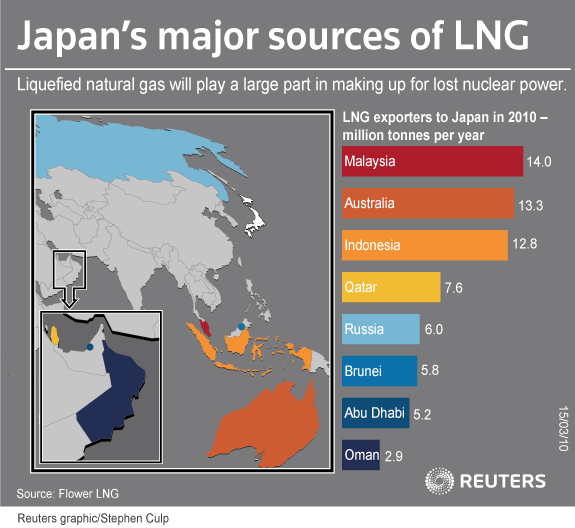

Sunday, March 20, 2011
Kogas to Send Up to 500,000 Tonnes of LNG to Japan
LNG World News, Mar 18, 2011
South Korea said on Friday Korea Gas Corp (KOGAS), the world’s top corporate buyer of liquefied natural gas (LNG), would supply 400,000-500,000 tonnes of LNG to quake-hit Japan, as requested by Japanese utilities.
South Korea’s economy ministry said in a statement that the state-run entity’s gas supply on a swap basis would be made from late March through April, following a government announcement on the supply plan on Sunday.
Global LNG prices jumped about 10 percent this week after Friday’s earthquake shut nuclear power plants in the world’s third-largest economy [after the U.S. and China], prompting increased demand for LNG.
Analysts reckon the world’s top LNG buyer may import about an extra 1 billion cubic feet per day to make up for the 9 gigawatts of nuclear power lost.
“We will continue to discuss with Japan possible further supplies if needed, while we maintain sufficient inventory levels,” said a government source with direct knowledge of the matter, who declined to be identified. [...]
South Korea’s current LNG inventory stands at 1.5 million tonnes, adding that supply to Japan would come from incoming shipments, not current inventory, the source said.
The ministry also noted South Korea’s emergency oil product and boron supply to Japan, referring to about 4.5 million barrels of shipments by four Korean refiners, as Japanese refiners grapple with the loss of about a third of their 4.5 million barrel-per-day refining capacity [sic].
Japan’s worst quake on record, which sparked a nuclear crisis, has caused the loss of around 9,700 megawatts (MW) of nuclear and 10,831 MW of thermal power generation.
To help stop fission nuclear reactions, South Korea said on Wednesday it would send some of its reserve boron to Japan after a request from Tokyo for the metalloid, which is being mixed with seawater to limit damage to Japan’s crippled nuclear reactors. [Read full]
(Japan is the third largest oil consumer in the world behind the United States and China and the third-largest net importer of crude oil. It is the world's largest importer of both LNG and coal---please see Japan Energy Profile, prepared by the U.S. EIA, here. For information on Japan's nuclear crisis and its impact, please see also my posts under the category/label "Japan." South Korea is the world's second largest importer of LNG. For Asian LNG market, please see my posts here and here. -- D.R.)
South Korea said on Friday Korea Gas Corp (KOGAS), the world’s top corporate buyer of liquefied natural gas (LNG), would supply 400,000-500,000 tonnes of LNG to quake-hit Japan, as requested by Japanese utilities.
South Korea’s economy ministry said in a statement that the state-run entity’s gas supply on a swap basis would be made from late March through April, following a government announcement on the supply plan on Sunday.
Global LNG prices jumped about 10 percent this week after Friday’s earthquake shut nuclear power plants in the world’s third-largest economy [after the U.S. and China], prompting increased demand for LNG.
Analysts reckon the world’s top LNG buyer may import about an extra 1 billion cubic feet per day to make up for the 9 gigawatts of nuclear power lost.
“We will continue to discuss with Japan possible further supplies if needed, while we maintain sufficient inventory levels,” said a government source with direct knowledge of the matter, who declined to be identified. [...]
South Korea’s current LNG inventory stands at 1.5 million tonnes, adding that supply to Japan would come from incoming shipments, not current inventory, the source said.
The ministry also noted South Korea’s emergency oil product and boron supply to Japan, referring to about 4.5 million barrels of shipments by four Korean refiners, as Japanese refiners grapple with the loss of about a third of their 4.5 million barrel-per-day refining capacity [sic].
Japan’s worst quake on record, which sparked a nuclear crisis, has caused the loss of around 9,700 megawatts (MW) of nuclear and 10,831 MW of thermal power generation.
To help stop fission nuclear reactions, South Korea said on Wednesday it would send some of its reserve boron to Japan after a request from Tokyo for the metalloid, which is being mixed with seawater to limit damage to Japan’s crippled nuclear reactors. [Read full]
(Japan is the third largest oil consumer in the world behind the United States and China and the third-largest net importer of crude oil. It is the world's largest importer of both LNG and coal---please see Japan Energy Profile, prepared by the U.S. EIA, here. For information on Japan's nuclear crisis and its impact, please see also my posts under the category/label "Japan." South Korea is the world's second largest importer of LNG. For Asian LNG market, please see my posts here and here. -- D.R.)
Wednesday, March 16, 2011
Japan May Need 200,000 Extra Barrels of Oil Daily, IEA Says
By
Oil demand in Japan may climb by about 200,000 barrels a day if the country makes up the shortfall in nuclear power with crude-fired generation, the International Energy Agency said.
Japan shut 11 atomic reactors totaling about 9.7 gigawatts of capacity [or some 20% of Japan’s total nuclear power generation capacity] after being struck on March 11 by its largest recorded earthquake. [For Japan's nuclear crisis, please see my posts here and here. -- D.R.]. The country has enough spare oil-fired plants to make up the loss, using only 30 percent of the crude generation units in 2009, the IEA said in its monthly Oil Market Report today.
Increasing the country’s natural gas-fired generation may also replace the lost nuclear plants, the agency said. Japan’s gas plants are currently running at only 55 percent of capacity.
“If the shortfall were met entirely by oil, consumption would increase by roughly 200,000 barrels a day on an annual basis,” the report said. “The generation of an extra 60 terawatt-hours using only gas would require plants to operate at near 70 percent of capacity, implying an additional 12 billion cubic meters of liquefied natural gas a year.” [Full story]
Oil demand in Japan may climb by about 200,000 barrels a day if the country makes up the shortfall in nuclear power with crude-fired generation, the International Energy Agency said.
Japan shut 11 atomic reactors totaling about 9.7 gigawatts of capacity [or some 20% of Japan’s total nuclear power generation capacity] after being struck on March 11 by its largest recorded earthquake. [For Japan's nuclear crisis, please see my posts here and here. -- D.R.]. The country has enough spare oil-fired plants to make up the loss, using only 30 percent of the crude generation units in 2009, the IEA said in its monthly Oil Market Report today.
Increasing the country’s natural gas-fired generation may also replace the lost nuclear plants, the agency said. Japan’s gas plants are currently running at only 55 percent of capacity.
“If the shortfall were met entirely by oil, consumption would increase by roughly 200,000 barrels a day on an annual basis,” the report said. “The generation of an extra 60 terawatt-hours using only gas would require plants to operate at near 70 percent of capacity, implying an additional 12 billion cubic meters of liquefied natural gas a year.” [Full story]
Monday, March 14, 2011
Water Injected into Troubled Nuclear Power Plant to Avert Disaster
Kyodo News, Tokyo, Mar 14, 2011
Japanese authorities scrambled Sunday to avert a nuclear disaster, injecting seawater into overheating reactors and relieving the pressure inside a nuclear power plant in Fukushima Prefecture that was hit and shut down as a result of Friday's devastating earthquake.
While acknowledging that fuel rods of the No. 3 reactor at the Fukushima No. 1 [Daiichi] plant [150 miles---240km---north of Tokyo] may have been deformed due to excessive heat, Chief Cabinet Secretary Yukio Edano denied it has led to a ''meltdown,'' a critical situation where fuel rods have melted and been destroyed.
Hidehiko Nishiyama, a senior official of the Economy, Trade and Industry Ministry indicated, however, that the reactor core has melted partially, telling a news conference, ''I don't think the fuel rods themselves have been spared damage.''
Cooling failure led the fuel rods at another reactor at the same plant to partially melt Saturday, and an ensuing explosion that blew away part of a building housing the reactor triggered fears of a nuclear disaster.
Edano, the top government spokesman, warned that a hydrogen explosion similar to one that hit the No. 1 reactor could occur at the No. 3 reactor.
Large amounts of hydrogen were formed when the water injection procedure temporarily ran into trouble and hydrogen may have filled the upper part of a building housing the No. 3 reactor, Edano said at a separate news conference.
The developments came after the cooling systems for some of the plant's reactors failed following the magnitude 9.0 earthquake and tsunami caused by it hit northeastern and eastern Japan on Friday.
The plant operator, Tokyo Electric Power Co., commonly known as TEPCO, began injecting fresh water into the No. 3 reactor on Sunday after coolant water levels fell, while letting out radioactive steam to relieve pressure that had built up inside.
But after trouble developed with a fresh water pump, the company was forced to pour seawater into it to avoid a meltdown, a step that will eventually lead to the reactor's dismantlement. As a result, water levels rose but the water-level gauge has stopped indicating a rise, Edano said.
An official of the government's Nuclear and Industrial Safety Agency said half of the roughly 4-meter rods were still exposed late Sunday, but that seawater kept being pumped into the reactor vessel.
The procedure temporarily exposed the top parts of MOX fuel rods above coolant water by nearly 3 meters. MOX fuel refers to plutonium-uranium mixed oxide fuel, used for so-called ''pluthermal'' power generation.
Radiation around the reactor rose three times the benchmark limit to 1,557 micro sievert per hour at 1:52 p.m. Sunday, but the figure went down to 184 about 50 minutes later. Given the radiation level, Edano said a hydrogen explosion is unlikely to affect human health even if one occurred.
Meanwhile, radiation monitored at the Onagawa nuclear power plant in Miyagi Prefecture on the Pacific coast shot up from late Saturday through early Sunday, Tohoku Electric Power Co. said, adding that radiation levels were low but about 700 times as high as normal.
The government agency said it was likely caused by radioactive substances that scattered when a hydrogen explosion hit the troubled Fukushima plant, about 120 kilometers south.
The No. 3 reactor was the sixth reactor overall at the Fukushima No. 1 and No. 2 plants, which are located about 11 km apart, to experience cooling failure since the massive earthquake and ensuing tsunami struck the power facilities.
The nuclear crisis has raised fears of radiation exposure.
Nineteen people who had evacuated from an area within 3 km of the No. 1 plant were found exposed to radiation, joining three others already confirmed to have been exposed, the Fukushima prefectural government said Sunday.
In addition, about 160 people are feared to have been exposed to radiation, according to the government agency.
The Fire and Disaster Management Agency said 15 people were found to have been contaminated with radioactive material at a hospital located within 10 km of the reactor.
To measure radiation for residents who may have been exposed to it and determine whether they need emergency treatment, the National Institute of Radiological Sciences sent 17 doctors and experts to the city of Fukushima on Sunday.
Edano, the chief Cabinet secretary, said there is little likelihood that radiation to which some residents have been exposed was serious enough to cause health damage.
Meanwhile, electric power companies in other regions and Japan Nuclear Fuel Ltd. have dispatched a total of 48 people to help TEPCO deal with the crisis at the two nuclear power plants in Fukushima.
Late Sunday, Masataka Shimizu, president of TEPCO, apologized for causing the leaks of radioactive substances, while blaming tsunami beyond their projections for the reactor failures.
''The tsunami was greater than we had projected,'' he said at a news conference. ''The largest factor was that we lost function due to equipment failure (caused by the tsunami).''
An explosion Saturday at the No. 1 plant blew away the roof and part of the walls of the building housing its No. 1 reactor's container.
The government and nuclear authorities said there was no damage to a steel container housing the reactor, noting that the blast occurred as vapor from the container turned into hydrogen and mixed with oxygen outside.
On Sunday, TEPCO continued new cooling operations to fill the troubled No. 1 reactor with seawater and pour in boric acid to prevent an occurrence of criticality.
The country's first partial melting of a reactor core was confirmed Saturday through the detection near the facility of radioactive cesium and iodine -- materials created following atomic fission.
Coolant water had been being pumped into the No. 3 reactor through supply equipment since the reactor shut down automatically following the quake, but the supply stopped on Sunday morning, making it necessary to pump seawater into the facility.
Following the explosion, the authorities expanded from 10 km to 20 km [12 miles] the radius of the evacuation area for residents living in the vicinity of the Fukushima plants. [Full story]
(Japan's nuclear safety agency rated the No. 1 reactor explosion at four on the international scale of zero to seven. The 1979 Three Mile Island accident in the United States was rated five, while the 1986 Chernobyl disaster was a seven. Russia is boosting LNG supplies to Japan, which is facing electric power shortages after Friday's massive earthquake shut nuclear reactors located in the worst affected areas. TEPCO said Monday it will start an unprecedented rationing of power at 10 a.m. or later rather than 6:20 a.m. as initially planned in the wake of Friday's powerful earthquake that hit Japan and crippled some nuclear power plants. Japan gets about 30% of its electricity from nuclear power. A hydrogen explosion occurred Monday morning at the quake-hit Fukushima No. 1 nuclear power plant's troubled No. 3 reactor, injuring three workers, but the reactor's container was not damaged, the government's nuclear safety agency and the plant's operator said. ''We judge that the possibility of a large amount of radioactive materials flying off from there is low,'' Chief Cabinet Secretary Yukio Edano told a news conference, adding that the injection of seawater to cool down the No. 3 reactor is continuing. -- D.R.)
Japanese authorities scrambled Sunday to avert a nuclear disaster, injecting seawater into overheating reactors and relieving the pressure inside a nuclear power plant in Fukushima Prefecture that was hit and shut down as a result of Friday's devastating earthquake.
While acknowledging that fuel rods of the No. 3 reactor at the Fukushima No. 1 [Daiichi] plant [150 miles---240km---north of Tokyo] may have been deformed due to excessive heat, Chief Cabinet Secretary Yukio Edano denied it has led to a ''meltdown,'' a critical situation where fuel rods have melted and been destroyed.
Hidehiko Nishiyama, a senior official of the Economy, Trade and Industry Ministry indicated, however, that the reactor core has melted partially, telling a news conference, ''I don't think the fuel rods themselves have been spared damage.''
Cooling failure led the fuel rods at another reactor at the same plant to partially melt Saturday, and an ensuing explosion that blew away part of a building housing the reactor triggered fears of a nuclear disaster.
Edano, the top government spokesman, warned that a hydrogen explosion similar to one that hit the No. 1 reactor could occur at the No. 3 reactor.
Large amounts of hydrogen were formed when the water injection procedure temporarily ran into trouble and hydrogen may have filled the upper part of a building housing the No. 3 reactor, Edano said at a separate news conference.
The developments came after the cooling systems for some of the plant's reactors failed following the magnitude 9.0 earthquake and tsunami caused by it hit northeastern and eastern Japan on Friday.
The plant operator, Tokyo Electric Power Co., commonly known as TEPCO, began injecting fresh water into the No. 3 reactor on Sunday after coolant water levels fell, while letting out radioactive steam to relieve pressure that had built up inside.
But after trouble developed with a fresh water pump, the company was forced to pour seawater into it to avoid a meltdown, a step that will eventually lead to the reactor's dismantlement. As a result, water levels rose but the water-level gauge has stopped indicating a rise, Edano said.
An official of the government's Nuclear and Industrial Safety Agency said half of the roughly 4-meter rods were still exposed late Sunday, but that seawater kept being pumped into the reactor vessel.
The procedure temporarily exposed the top parts of MOX fuel rods above coolant water by nearly 3 meters. MOX fuel refers to plutonium-uranium mixed oxide fuel, used for so-called ''pluthermal'' power generation.
Radiation around the reactor rose three times the benchmark limit to 1,557 micro sievert per hour at 1:52 p.m. Sunday, but the figure went down to 184 about 50 minutes later. Given the radiation level, Edano said a hydrogen explosion is unlikely to affect human health even if one occurred.
Meanwhile, radiation monitored at the Onagawa nuclear power plant in Miyagi Prefecture on the Pacific coast shot up from late Saturday through early Sunday, Tohoku Electric Power Co. said, adding that radiation levels were low but about 700 times as high as normal.
The government agency said it was likely caused by radioactive substances that scattered when a hydrogen explosion hit the troubled Fukushima plant, about 120 kilometers south.
The No. 3 reactor was the sixth reactor overall at the Fukushima No. 1 and No. 2 plants, which are located about 11 km apart, to experience cooling failure since the massive earthquake and ensuing tsunami struck the power facilities.
The nuclear crisis has raised fears of radiation exposure.
Nineteen people who had evacuated from an area within 3 km of the No. 1 plant were found exposed to radiation, joining three others already confirmed to have been exposed, the Fukushima prefectural government said Sunday.
In addition, about 160 people are feared to have been exposed to radiation, according to the government agency.
The Fire and Disaster Management Agency said 15 people were found to have been contaminated with radioactive material at a hospital located within 10 km of the reactor.
To measure radiation for residents who may have been exposed to it and determine whether they need emergency treatment, the National Institute of Radiological Sciences sent 17 doctors and experts to the city of Fukushima on Sunday.
Edano, the chief Cabinet secretary, said there is little likelihood that radiation to which some residents have been exposed was serious enough to cause health damage.
Meanwhile, electric power companies in other regions and Japan Nuclear Fuel Ltd. have dispatched a total of 48 people to help TEPCO deal with the crisis at the two nuclear power plants in Fukushima.
Late Sunday, Masataka Shimizu, president of TEPCO, apologized for causing the leaks of radioactive substances, while blaming tsunami beyond their projections for the reactor failures.
''The tsunami was greater than we had projected,'' he said at a news conference. ''The largest factor was that we lost function due to equipment failure (caused by the tsunami).''
An explosion Saturday at the No. 1 plant blew away the roof and part of the walls of the building housing its No. 1 reactor's container.
The government and nuclear authorities said there was no damage to a steel container housing the reactor, noting that the blast occurred as vapor from the container turned into hydrogen and mixed with oxygen outside.
On Sunday, TEPCO continued new cooling operations to fill the troubled No. 1 reactor with seawater and pour in boric acid to prevent an occurrence of criticality.
The country's first partial melting of a reactor core was confirmed Saturday through the detection near the facility of radioactive cesium and iodine -- materials created following atomic fission.
Coolant water had been being pumped into the No. 3 reactor through supply equipment since the reactor shut down automatically following the quake, but the supply stopped on Sunday morning, making it necessary to pump seawater into the facility.
Following the explosion, the authorities expanded from 10 km to 20 km [12 miles] the radius of the evacuation area for residents living in the vicinity of the Fukushima plants. [Full story]
(Japan's nuclear safety agency rated the No. 1 reactor explosion at four on the international scale of zero to seven. The 1979 Three Mile Island accident in the United States was rated five, while the 1986 Chernobyl disaster was a seven. Russia is boosting LNG supplies to Japan, which is facing electric power shortages after Friday's massive earthquake shut nuclear reactors located in the worst affected areas. TEPCO said Monday it will start an unprecedented rationing of power at 10 a.m. or later rather than 6:20 a.m. as initially planned in the wake of Friday's powerful earthquake that hit Japan and crippled some nuclear power plants. Japan gets about 30% of its electricity from nuclear power. A hydrogen explosion occurred Monday morning at the quake-hit Fukushima No. 1 nuclear power plant's troubled No. 3 reactor, injuring three workers, but the reactor's container was not damaged, the government's nuclear safety agency and the plant's operator said. ''We judge that the possibility of a large amount of radioactive materials flying off from there is low,'' Chief Cabinet Secretary Yukio Edano told a news conference, adding that the injection of seawater to cool down the No. 3 reactor is continuing. -- D.R.)
Thursday, March 10, 2011
Eurogas: EU 27 Gas Consumption Rises 7.2% in 2010
by Doris Leblond, Paris, OGJ, Mar 9, 2011
Preliminary figures from Eurogas indicate that total gas consumption for the European Union 27 [...] increased by 7.2% to 522 billion cu m in 2010 vs. 2009. In 2009, the economic crisis had pulled down consumption to its lowest level since 2002.
The growth was due to a combination of severe weather conditions, which strongly pushed up demand from the residential sector, and economic recovery illustrated by the 1.8% real GDP growth and the 6.6% [sic] increase in the EU 27 average production index for 2010.
Higher electricity demand due to economic recovery combined with the switch to gas from other fuels for electric power generation, which significantly contributed to total demand growth.
Indigenous gas production fell by 4% to 176 bcm in 2010, mainly because of the decline in mature production basins. However, with a 34% share [of the total net supplies -- D.R], it is still the largest source of gas for the EU 27. Main external sources were Russia, 23%; Norway, 19%; Algeria, 10%; and Qatar, 6%; the latter two countries showed an increasing role as LNG suppliers to Europe.
The UK was the largest gas consumer in 2010 with 99.8 bcm. [Estonia] [...] was the smallest with [0.5] bcm ... of gas consumed. Other countries’ gas consumption numbers were, [in order]: Germany, 87 bcm; Italy, 81.1 bcm; France, 50.7 bcm; the Netherland, 46.8 bcm; Spain, 37 bcm; [Belgium, 19.9 bcm] and [Poland, 15.5 bcm] [...].
(Cyprus and Malta are the only two EU member states that do not consume natural gas. However, the US' Noble Energy plans to start work on an exploration well in block 12 offshore Cyprus at end-2011 in an attempt to prove the country's gas potential. Both Cyprus and Malta have been oil import-dependent countries. Among the Baltic States (in the narrower sense), Lithuania was the largest consumer of natural gas with 3 bcm in 2010, followed by Latvia, 1.7 bcm and Estonia, 0.5 bcm---please see Eurogas original report -- Natural Gas Consumption in the EU27 and Switzerland in 2010, Mar 7, 2011, here. For information on EU plans to import gas from Azerbaijan, please see my post here. -- D.R.)
Preliminary figures from Eurogas indicate that total gas consumption for the European Union 27 [...] increased by 7.2% to 522 billion cu m in 2010 vs. 2009. In 2009, the economic crisis had pulled down consumption to its lowest level since 2002.
The growth was due to a combination of severe weather conditions, which strongly pushed up demand from the residential sector, and economic recovery illustrated by the 1.8% real GDP growth and the 6.6% [sic] increase in the EU 27 average production index for 2010.
Higher electricity demand due to economic recovery combined with the switch to gas from other fuels for electric power generation, which significantly contributed to total demand growth.
Indigenous gas production fell by 4% to 176 bcm in 2010, mainly because of the decline in mature production basins. However, with a 34% share [of the total net supplies -- D.R], it is still the largest source of gas for the EU 27. Main external sources were Russia, 23%; Norway, 19%; Algeria, 10%; and Qatar, 6%; the latter two countries showed an increasing role as LNG suppliers to Europe.
The UK was the largest gas consumer in 2010 with 99.8 bcm. [Estonia] [...] was the smallest with [0.5] bcm ... of gas consumed. Other countries’ gas consumption numbers were, [in order]: Germany, 87 bcm; Italy, 81.1 bcm; France, 50.7 bcm; the Netherland, 46.8 bcm; Spain, 37 bcm; [Belgium, 19.9 bcm] and [Poland, 15.5 bcm] [...].
(Cyprus and Malta are the only two EU member states that do not consume natural gas. However, the US' Noble Energy plans to start work on an exploration well in block 12 offshore Cyprus at end-2011 in an attempt to prove the country's gas potential. Both Cyprus and Malta have been oil import-dependent countries. Among the Baltic States (in the narrower sense), Lithuania was the largest consumer of natural gas with 3 bcm in 2010, followed by Latvia, 1.7 bcm and Estonia, 0.5 bcm---please see Eurogas original report -- Natural Gas Consumption in the EU27 and Switzerland in 2010, Mar 7, 2011, here. For information on EU plans to import gas from Azerbaijan, please see my post here. -- D.R.)
Tuesday, March 8, 2011
Petrobras Announces Third LNG Terminal
by OGJ editors, OGJ, Mar 2, 2011
Petroleo Brasileiro SA (Petrobras) reported it will install a third offshore LNG terminal.
The Bahia regasification terminal (TRBA), with capacity to regasify 14 million cu m/day (cmd), will supply natural gas to the state of Bahia, the heaviest consumer of gas among the northeastern Brazilian states.
TRBA will be installed in the Bay of All Saints and interconnect with a pipeline network at two sites: one in the Bahia network, at Candeias, and the other at kilometer 910 on the Cacimbas-Catu pipeline, a section of the Southeast-Northeast Gas Pipeline started up in March 2010.
As part of Brazil’s Growth Acceleration Program, Petrobras said, work will begin in March 2012 with completion scheduled for August 2013 under an investment of nearly $425 million.
Currently, Brazil has LNG terminals at Pecem (State of Ceara) with a regasification capacity of 7 million cmd, and in the Guanabara Bay (State of Rio de Janeiro) with capacity of 14 million cmd. When the TRBA terminal comes online in September 2013, Brazil’s total regasification capacity will reach 35 million cmd, overtaking the gas imports via pipeline from Bolivia (31 million cmd).
At the Pecem and Guanabara Bay terminals, tankers moor at a two-berth pier and LNG is transferred over cryogenic arms from supply vessel to regasification vessel. At the TRBA terminal, LNG will be transferred directly between vessels using side-by-side docking, which means that the regasification vessel will dock at a single-berth, island-type pier, said the company.
With direct connection to the supply vessel, LNG will be transferred over short hoses or loading arms to the regasification vessel, which will convert LNG back into a vapor [i.e., gaseous state].
Gas will then be injected into the pipeline network through a 28-in. pipeline that is 49 km long including a 15-km subsea section.
Petrobras noted that currently only two [sic] other LNG terminals in the world use this configuration [i.e., side-by-side -- D.R.]: Bahia Blanca in Argentina and the UAE’s Dubai terminal. [Full story]
(Brazil imported 298 Bcf of natural gas in 2009, a 24 percent drop from 2008. The decline in Brazilian overall natural gas demand, coupled with policy choices aimed at reducing imports, led to this decline. The country currently receives imports by pipeline from Bolivia and liquefied natural gas (LNG) imports from Trinidad and Tobago and Nigeria. Import growth in the future is expected to be met more with LNG than with conventional pipeline imports. Brazil imports natural gas from Bolivia via the Gasbol pipeline, which links Santa Cruz, Bolivia to Porto Alegre, Brazil, via Sao Paulo. The 2,000-mile Gasbol has a maximum capacity of 1.1 Bcf per day (Bcf/d). In early 2009, Brazil announced that it would reduce imports from Bolivia from 1.1 Bcf/d to 0.7 Bcf/d. According to ANP, Brazilian imports of Bolivian gas have since declined by 27 percent. However, Bolivia still accounted for 96 percent of Brazil’s total natural gas imports. The Pecem---please see image below---received its first LNG cargo from Trinidad and Tobago in July 2008, while the Guanabara Bay terminal came online in May 2009. According to ANP, Brazil received 15 Bcf of natural gas in the form of LNG in 2009, mostly from Trinidad and Tobago---please see U.S. EIA, Brazil Country Analysis Brief, Jan 2011, here. For the Petrobras's standing in the company rankings---PIW's and others---please see my blog stand-alone page "Companies" > Petrobras, here. -- D.R.)
 Source: LNGpedia.com here Description: The Floating Storage and Regasification Unit---FSRU---vessel, the Golar Spirit, is reportedly the world's first methane vessel to have been converted to perform LNG regasification on board. The regasification capacity of the Golar Spirit is seven million cubic meters (cbm) per day, and its storage capacity is 129,000 cbm of LNG, equivalent to 77 million cbm of natural gas.
Petroleo Brasileiro SA (Petrobras) reported it will install a third offshore LNG terminal.
The Bahia regasification terminal (TRBA), with capacity to regasify 14 million cu m/day (cmd), will supply natural gas to the state of Bahia, the heaviest consumer of gas among the northeastern Brazilian states.
TRBA will be installed in the Bay of All Saints and interconnect with a pipeline network at two sites: one in the Bahia network, at Candeias, and the other at kilometer 910 on the Cacimbas-Catu pipeline, a section of the Southeast-Northeast Gas Pipeline started up in March 2010.
As part of Brazil’s Growth Acceleration Program, Petrobras said, work will begin in March 2012 with completion scheduled for August 2013 under an investment of nearly $425 million.
Currently, Brazil has LNG terminals at Pecem (State of Ceara) with a regasification capacity of 7 million cmd, and in the Guanabara Bay (State of Rio de Janeiro) with capacity of 14 million cmd. When the TRBA terminal comes online in September 2013, Brazil’s total regasification capacity will reach 35 million cmd, overtaking the gas imports via pipeline from Bolivia (31 million cmd).
At the Pecem and Guanabara Bay terminals, tankers moor at a two-berth pier and LNG is transferred over cryogenic arms from supply vessel to regasification vessel. At the TRBA terminal, LNG will be transferred directly between vessels using side-by-side docking, which means that the regasification vessel will dock at a single-berth, island-type pier, said the company.
With direct connection to the supply vessel, LNG will be transferred over short hoses or loading arms to the regasification vessel, which will convert LNG back into a vapor [i.e., gaseous state].
Gas will then be injected into the pipeline network through a 28-in. pipeline that is 49 km long including a 15-km subsea section.
Petrobras noted that currently only two [sic] other LNG terminals in the world use this configuration [i.e., side-by-side -- D.R.]: Bahia Blanca in Argentina and the UAE’s Dubai terminal. [Full story]
(Brazil imported 298 Bcf of natural gas in 2009, a 24 percent drop from 2008. The decline in Brazilian overall natural gas demand, coupled with policy choices aimed at reducing imports, led to this decline. The country currently receives imports by pipeline from Bolivia and liquefied natural gas (LNG) imports from Trinidad and Tobago and Nigeria. Import growth in the future is expected to be met more with LNG than with conventional pipeline imports. Brazil imports natural gas from Bolivia via the Gasbol pipeline, which links Santa Cruz, Bolivia to Porto Alegre, Brazil, via Sao Paulo. The 2,000-mile Gasbol has a maximum capacity of 1.1 Bcf per day (Bcf/d). In early 2009, Brazil announced that it would reduce imports from Bolivia from 1.1 Bcf/d to 0.7 Bcf/d. According to ANP, Brazilian imports of Bolivian gas have since declined by 27 percent. However, Bolivia still accounted for 96 percent of Brazil’s total natural gas imports. The Pecem---please see image below---received its first LNG cargo from Trinidad and Tobago in July 2008, while the Guanabara Bay terminal came online in May 2009. According to ANP, Brazil received 15 Bcf of natural gas in the form of LNG in 2009, mostly from Trinidad and Tobago---please see U.S. EIA, Brazil Country Analysis Brief, Jan 2011, here. For the Petrobras's standing in the company rankings---PIW's and others---please see my blog stand-alone page "Companies" > Petrobras, here. -- D.R.)

Subscribe to:
Posts (Atom)