by OGJ editors, OGJ, Houston, Sept 6, 2011
Sunoco Inc., Philadelphia, hopes to sell its remaining two refineries and plans to leave the oil refining business to complete what it calls “a fundamental shift away from manufacturing.” [Please see remarks below -- D.R.]
The company has retained Credit Suisse Securities (USA) LLC to help it review strategy.
It will try to sell its 330,000-b/cd refinery in Philadelphia and 175,000-b/cd facility at Marcus Hook, Pa. If unsuccessful, it will idle the main processing units in July 2012.
Key processing capacities at Philadelphia are 113,500 b/cd of fluid catalytic cracking, 68,000 b/d of catalytic reforming, 85,600 b/cd of catalytic hydrotreating for pretreatment of reformer feeds, and 78,000 b/cd of cat hydrotreating for diesel desulfurization. The Philadelphia refinery also has 16,700 b/d of alkylation (hydrofluoric acid) capacity.
The Marcus Hook refinery has capacities of 93,000 b/cd for FCC, 15,600 b/cd for cat reforming, 36,000 b/cd of cat hydrotreating for reformer feed, and 12,000 b/cd of posthydotreating for FCC naphtha. It has 10,000 b/d of alkylation (sulfuric acid) capacity.
Restructuring
Sunoco has been restructuring for several years. Earlier this year it completed the sale of its 170,000 b/d refinery in Toledo, Ohio, to Toledo Refining Co. LLC, a unit of PBF Holding Co. LLC (OGJ Online, Mar. 1, 2011).
In 2010 it shut a 150,000 b/d refinery at Eagle Point, NJ, and [in 2009 -- D.R.] sold an 85,000-b/d refinery in Tulsa to Holly Corp. (OGJ Online, June 16, 2010).
It also sold its polypropylene [PP -- D.R.] business, Sunoco Chemicals Inc., to Braskem SA, and shut down a PP plant in Texas (OGJ Online, Apr. 6, 2010). And it is separating its metallurgical coke business through an initial public offering of shares in SunCoke Energy.
The company expects to incur pretax noncash charges of $1.9-2.2 billion in the third quarter as it exits refining. The charges relate to impairment of plant and equipment. If it must idle process units, it expects additional pretax charges of as much as $500 million related to contract terminations, staffing costs, and severance.
Sunoco has been expanding its remaining business units, retail marketing and logistics.
The company has more than 4,900 branded retail locations in 24 states, with APlus convenience stores operated by it or dealers in 600 of the retail outlets.
It also holds 35% [sic -- D.R.] interest in and is general partner of Sunoco Logistics Partners LP, a publicly traded master limited partnership that operates 3,350 miles of crude oil trunkline, 500 miles of crude oil gathering lines, and 2,500 miles of oil product pipelines. [Full story]
(Please see Sunoco's website/news room: "Sunoco to Exit Refining and Conduct Strategic Review of the Company," Sept 6, 2011. As of Jan 1, 2011, Sunoco, with crude oil distillation capacity of its three refineries---Marcus Hook, Toledo and Philadelphia---of 673,000 barrels per day, was ranked 10th on the list of top 20 U.S. refiners---please see my post "Top 20 Largest Refining Companies/Refiners in the U.S. as of Jan 1, 2011." PBF Energy Company LLC on Tuesday, March 1, 2011, announced that its subsidiary, Toledo Refining Company LLC, has completed its purchase of the Toledo Refinery in Ohio from Sunoco, Inc. It is worthy of note that Sunoco has owned refineries for 117 years. Formerly known as the Sun Oil Company of Ohio, it bought its first refinery in 1894. -- D.R.)
Showing posts with label Pipelines. Show all posts
Showing posts with label Pipelines. Show all posts
Friday, September 9, 2011

Tuesday, June 14, 2011
[...] US Ambassador [to Canada] Backs Increased Canadian Oil-Sands Imports
Petroleum Economist, June 9, 2011
The US government considers Canadian oil supplies an essential ingredient of energy security, even as competition for resources and assets ratchets up with rival China.
Speaking in Calgary, US ambassador to Canada David Jacobson described his country's need for greater imports from stable sources such as Canada to offset dependence on unstable regimes in the Middle East and North Africa. "The US sees Canada as a pillar of our energy security," he said.
It is already the largest energy-trading relationship in history, with Canada accounting for about 22% of US import demand [please see my post "U.S. Crude Oil Imports from Top 15 Countries, Dec 2010 and Full Year 2010," -- Canada supplied about 22% of total US crude oil imports in 2010, i.e., 1.97 million b/d of crude/please also see chart below, out of a total US imports of crude of 9.16 million b/d, as well as about 22% of total US crude oil and products imports in 2010, i.e., 2.532 million barrels per day---1.97 million b/d of crude oil plus 0.56 million b/d of petroleum products---out of a total US imports of crude and products of 11.753 million b/d -- D.R.). Alberta alone pumps about 1.4 million b/d to US refineries or 7% of overall US consumption [U.S. oil consumption increased by some 380,000 b/d or 2.0% to 19.148 million b/d in 2010, compared to the previous year---please see my post "Top 25 World Oil Consumers, 2009-2010." Separately, of the estimated 2.9 million b/d, sic, of crude oil produced in Canada in 2010, 1.5 million b/d of that was derived from the oil sands of Alberta---please see EIA. -- D.R.].
Canada long ago surpassed Saudi Arabia as the top supplier to the world's largest oil consumer and that relationship is poised to grow exponentially as Canadian producers increase production of oil-sands crude.
Canadian exports to the US have more than doubled since 1993 [US imports from Canada of crude oil increased from 900,000 b/d in 1993 to 1,972,000 b/d in 2010, and US imports from Canada of crude oil and petroleum products increased from 1,181,000 b/d in 1993 to 2,532,000 b/d in 2010 -- D.R.] and are set to double and quadruple over the next two decades.
According to IHS Cera, Canadian oil sands could supply 6.3 million b/d by 2035, not including any other conventional and unconventional production that would push the figure past 7 million b/d. Only Russia and Saudi Arabia would have larger output, IHC Cera added, vaulting Canada into the top tier of oil-producing nations. [...]
But that looming reality seems lost on US President Barack Obama, who has seemed to be reluctant to fully embrace the oil sands even as he has talked of the need to reduce imports from unstable and hostile regimes.
A series of nagging doubts have led some Canadian observers to question the president's energy priorities. For instance, the State Department has held up approvals for TransCanada's Keystone XL pipeline to the Gulf coast [where there are more refineries capable of handling the unusually thick crude, i.e. the heavy, high-sulphur bitumen, and please see map below -- D.R.] while it carries out environmental assessments of the carbon intensity of Canadian oil sands and heavy crude in a move seen as bowing to environmental groups. [...]
[Click on map to enlarge]
 Source: PE, here.
Fearing the worst from Obama's climate-change and clean-energy initiatives, the Canadian and Alberta governments have lobbied against the adoption of clean-fuel standards and other environmental policies they claim would discriminate against Canada. [...]
Feeling snubbed by this seeming US indifference, Canada has been courting Asia, and particularly the Chinese, as an alternate buyer of its growing output.
China consumes less than half as much oil as the US [please see my posts "Top 25 World Oil Consumers, 2009-2010 -- EIA." and "Top 21 World Oil Consumers, 2007-2010 -- BP," -- D.R.], but will overtake it in a matter of decades, said Wenran Jiang of the University of Alberta's China Institute [According to the BP Energy Outlook 2030, China is the largest source of oil consumption growth, with consumption forecast to grow by 8 million b/d a day to reach 17.5 million b/d by 2030, overtaking the US to become the world's largest oil consumer -- D.R.]. And like the US, China considers Canadian energy supplies to be vital to its security and economic growth.
About 80% of China's imports must pass through the Malacca Strait and its is keen to diversify supply chains away from vulnerable shipping lanes in Southeast Asia. [Also, please see my post "What is Beijing Willing to Do to Secure Oil and Gas Supplies?" and my post "China: Taking Oil Home," -- D.R.] [...]
While the US dithers over whether to embrace "dirty oil" [please see remarks below -- D.R.] from Canada, Chinese state-owned entities have been on a shopping spree, snapping up C$20 billion ($19.8 billion [sic]) worth of assets in less than two years and forming operating partnerships with Canadian firms for both oil sands and unconventional shale gas.
There is presently no way of shipping that oil to China, but there is a growing call in Canada to do just that.
Enbridge's proposed Northern Gateway pipeline to Canada's west coast is seen as a way of opening up overseas markets and gaining higher world oil prices. [Read more]
 Source: U.S. Energy Information Administration (EIA), Today in Energy, Jun 14, 2011, here.
(Canadian oil producers have been clamoring for an outlet for their oil to reach the Gulf Coast, reliving a glut that's accumulated in Cushing, Oklahoma, where several pipeline routes terminate --- the delivery point for the West Texas Intermediate benchmark. The large amount of oil stranded in Cushing has led to a deep discount in crude-oil prices in the region and on the New York Mercantile Exchange. In March, the U.S. State Department delayed approval of the 1.1-million-barrel-a-day TransCanada Corp. Keystone XL pipeline expansion that would bring Canadian oil to the Gulf of Mexico. Environmental groups have raised objections about the possibility of oil spills. Alberta Energy Minister Ron Liepert called for the U.S. State Department to quickly approve the extension of a controversial oil pipeline to the U.S., adding that Canada has other potential customers for its oil. Canada is the biggest supplier of foreign oil to the U.S. but Minister Liepert said Canada is "actively cultivating" relationships with China and other emerging markets, where energy demand is growing rapidly---please see MarketWatch, May 16, 2011. In regard to environmental concerns surrounding oil sands production, Minister Liepert states, “We have been a leader in terms of initiatives around the environment. We have made significant advancement in tailings [Tailings are a mixture of fine clay, silt, sand, water and residual bitumen produced through oil sands extraction -- D.R.] management. Tailings are associated only with the mining operations, which is less than 50 per cent of the oil sands production now and continues to decline as a percentage of production.” He continues, “We have a 15 dollar per ton carbon tax, and most of the large operations in the oil sands fall under that. The tax goes into a clean energy fund. Alberta only has a population of 3.5 million people, but has invested $2 billion—probably the largest of any jurisdiction in the world—into carbon capture and storage.”---please see Energy Digital, Jun 14, 2011. -- D.R.)
The US government considers Canadian oil supplies an essential ingredient of energy security, even as competition for resources and assets ratchets up with rival China.
Speaking in Calgary, US ambassador to Canada David Jacobson described his country's need for greater imports from stable sources such as Canada to offset dependence on unstable regimes in the Middle East and North Africa. "The US sees Canada as a pillar of our energy security," he said.
It is already the largest energy-trading relationship in history, with Canada accounting for about 22% of US import demand [please see my post "U.S. Crude Oil Imports from Top 15 Countries, Dec 2010 and Full Year 2010," -- Canada supplied about 22% of total US crude oil imports in 2010, i.e., 1.97 million b/d of crude/please also see chart below, out of a total US imports of crude of 9.16 million b/d, as well as about 22% of total US crude oil and products imports in 2010, i.e., 2.532 million barrels per day---1.97 million b/d of crude oil plus 0.56 million b/d of petroleum products---out of a total US imports of crude and products of 11.753 million b/d -- D.R.). Alberta alone pumps about 1.4 million b/d to US refineries or 7% of overall US consumption [U.S. oil consumption increased by some 380,000 b/d or 2.0% to 19.148 million b/d in 2010, compared to the previous year---please see my post "Top 25 World Oil Consumers, 2009-2010." Separately, of the estimated 2.9 million b/d, sic, of crude oil produced in Canada in 2010, 1.5 million b/d of that was derived from the oil sands of Alberta---please see EIA. -- D.R.].
Canada long ago surpassed Saudi Arabia as the top supplier to the world's largest oil consumer and that relationship is poised to grow exponentially as Canadian producers increase production of oil-sands crude.
Canadian exports to the US have more than doubled since 1993 [US imports from Canada of crude oil increased from 900,000 b/d in 1993 to 1,972,000 b/d in 2010, and US imports from Canada of crude oil and petroleum products increased from 1,181,000 b/d in 1993 to 2,532,000 b/d in 2010 -- D.R.] and are set to double and quadruple over the next two decades.
According to IHS Cera, Canadian oil sands could supply 6.3 million b/d by 2035, not including any other conventional and unconventional production that would push the figure past 7 million b/d. Only Russia and Saudi Arabia would have larger output, IHC Cera added, vaulting Canada into the top tier of oil-producing nations. [...]
But that looming reality seems lost on US President Barack Obama, who has seemed to be reluctant to fully embrace the oil sands even as he has talked of the need to reduce imports from unstable and hostile regimes.
A series of nagging doubts have led some Canadian observers to question the president's energy priorities. For instance, the State Department has held up approvals for TransCanada's Keystone XL pipeline to the Gulf coast [where there are more refineries capable of handling the unusually thick crude, i.e. the heavy, high-sulphur bitumen, and please see map below -- D.R.] while it carries out environmental assessments of the carbon intensity of Canadian oil sands and heavy crude in a move seen as bowing to environmental groups. [...]
[Click on map to enlarge]

Fearing the worst from Obama's climate-change and clean-energy initiatives, the Canadian and Alberta governments have lobbied against the adoption of clean-fuel standards and other environmental policies they claim would discriminate against Canada. [...]
Feeling snubbed by this seeming US indifference, Canada has been courting Asia, and particularly the Chinese, as an alternate buyer of its growing output.
China consumes less than half as much oil as the US [please see my posts "Top 25 World Oil Consumers, 2009-2010 -- EIA." and "Top 21 World Oil Consumers, 2007-2010 -- BP," -- D.R.], but will overtake it in a matter of decades, said Wenran Jiang of the University of Alberta's China Institute [According to the BP Energy Outlook 2030, China is the largest source of oil consumption growth, with consumption forecast to grow by 8 million b/d a day to reach 17.5 million b/d by 2030, overtaking the US to become the world's largest oil consumer -- D.R.]. And like the US, China considers Canadian energy supplies to be vital to its security and economic growth.
About 80% of China's imports must pass through the Malacca Strait and its is keen to diversify supply chains away from vulnerable shipping lanes in Southeast Asia. [Also, please see my post "What is Beijing Willing to Do to Secure Oil and Gas Supplies?" and my post "China: Taking Oil Home," -- D.R.] [...]
While the US dithers over whether to embrace "dirty oil" [please see remarks below -- D.R.] from Canada, Chinese state-owned entities have been on a shopping spree, snapping up C$20 billion ($19.8 billion [sic]) worth of assets in less than two years and forming operating partnerships with Canadian firms for both oil sands and unconventional shale gas.
There is presently no way of shipping that oil to China, but there is a growing call in Canada to do just that.
Enbridge's proposed Northern Gateway pipeline to Canada's west coast is seen as a way of opening up overseas markets and gaining higher world oil prices. [Read more]

(Canadian oil producers have been clamoring for an outlet for their oil to reach the Gulf Coast, reliving a glut that's accumulated in Cushing, Oklahoma, where several pipeline routes terminate --- the delivery point for the West Texas Intermediate benchmark. The large amount of oil stranded in Cushing has led to a deep discount in crude-oil prices in the region and on the New York Mercantile Exchange. In March, the U.S. State Department delayed approval of the 1.1-million-barrel-a-day TransCanada Corp. Keystone XL pipeline expansion that would bring Canadian oil to the Gulf of Mexico. Environmental groups have raised objections about the possibility of oil spills. Alberta Energy Minister Ron Liepert called for the U.S. State Department to quickly approve the extension of a controversial oil pipeline to the U.S., adding that Canada has other potential customers for its oil. Canada is the biggest supplier of foreign oil to the U.S. but Minister Liepert said Canada is "actively cultivating" relationships with China and other emerging markets, where energy demand is growing rapidly---please see MarketWatch, May 16, 2011. In regard to environmental concerns surrounding oil sands production, Minister Liepert states, “We have been a leader in terms of initiatives around the environment. We have made significant advancement in tailings [Tailings are a mixture of fine clay, silt, sand, water and residual bitumen produced through oil sands extraction -- D.R.] management. Tailings are associated only with the mining operations, which is less than 50 per cent of the oil sands production now and continues to decline as a percentage of production.” He continues, “We have a 15 dollar per ton carbon tax, and most of the large operations in the oil sands fall under that. The tax goes into a clean energy fund. Alberta only has a population of 3.5 million people, but has invested $2 billion—probably the largest of any jurisdiction in the world—into carbon capture and storage.”---please see Energy Digital, Jun 14, 2011. -- D.R.)
Monday, May 23, 2011
EPP to Extend Eagle Ford Crude Oil Pipeline
by Christopher E. Smith, OGJ Pipeline Editor, OGJ, May 6, 2011
Enterprise Products Partners LP plans to build an 80-mile extension of its 350,000-b/d Eagle Ford shale crude oil pipeline, allowing it to serve growing production areas in the southwestern portion of the play. The 200,000 b/d Phase II project would originate in Wilson County, Tex., at the terminus of Enterprise's previously announced 140-mile Phase I segment (OGJ Online, Sept. 30, 2010), and extend to a site near Gardendale, Tex., in La Salle County, where a new 500,000 bbl central delivery point is planned.
Phase I is on schedule to begin service by second-quarter 2012, according to EPP, with Phase II set to commence operations in first-quarter 2013. The roughly 220-mile pipeline system will provide Eagle Ford producers with access to the Texas Gulf Coast refining complex through EPP’s Sealy, Tex., delivery point. The Sealy facility interconnects with its Rancho Pipeline and feeds into EPP’s new ECHO crude oil storage terminal being constructed along the Houston Ship Channel in southeast Harris County, Tex. (OGJ Online, Nov. 11, 2010).
The Phase II extension is anchored by a 10-year, 100,000 b/d shipping agreement with Chesapeake Energy Marketing Inc., a subsidiary of Chesapeake Energy Corp. EPP said, including the Chesapeake agreement, it now has producer commitments for 320,000 b/d under 10-year contracts.
About 165 rigs are working in the Eagle Ford shale, having drilled more than 1,200 wells, Enterprise said. Current production from the play is roughly 100,000 b/d [of crude oil and condensate -- D.R.]. With more than 2.5 million acres under lease and potentially 15,000 wells to be drilled over the production life of the Phase II service area (based on EPP’s research and information it obtained from producers), the company expects development activity in this region of the Eagle Ford shale to remain brisk.
Estimates provided by producers also suggest that up to 3 billion bbl of crude oil are recoverable in the southwestern region of the play, EPP said. [Full story]
(Also, Plains All American Pipeline LP/PAA plans to build a 300,000 b/d, 130-mile crude oil and condensate pipeline, a marine terminal facility, and 1.5 million bbl of storage to serve growing Eagle Ford production in South Texas. A long-term throughput agreement with Chesapeake Energy Marketing Inc., a subsidiary of Chesapeake Energy Corp., underpins the construction plans. PAA expects the pipeline to enter service in fourth-quarter 2012 at a cost of about $330 million---please see OGJ, May 18, 2011. Separately, please see my post "BENTEK: Eagle Ford Crude Oil Production Expected to Grow Fivefold in Five Years," here. For maps of the Eagle Ford shale, please see here. For the map of North American shale plays from the U.S. Energy Information Administration/EIA, including the United States, Canada and Mexico, as of May 9, 2011, please see here. -- D.R.)
Enterprise Products Partners LP plans to build an 80-mile extension of its 350,000-b/d Eagle Ford shale crude oil pipeline, allowing it to serve growing production areas in the southwestern portion of the play. The 200,000 b/d Phase II project would originate in Wilson County, Tex., at the terminus of Enterprise's previously announced 140-mile Phase I segment (OGJ Online, Sept. 30, 2010), and extend to a site near Gardendale, Tex., in La Salle County, where a new 500,000 bbl central delivery point is planned.
Phase I is on schedule to begin service by second-quarter 2012, according to EPP, with Phase II set to commence operations in first-quarter 2013. The roughly 220-mile pipeline system will provide Eagle Ford producers with access to the Texas Gulf Coast refining complex through EPP’s Sealy, Tex., delivery point. The Sealy facility interconnects with its Rancho Pipeline and feeds into EPP’s new ECHO crude oil storage terminal being constructed along the Houston Ship Channel in southeast Harris County, Tex. (OGJ Online, Nov. 11, 2010).
The Phase II extension is anchored by a 10-year, 100,000 b/d shipping agreement with Chesapeake Energy Marketing Inc., a subsidiary of Chesapeake Energy Corp. EPP said, including the Chesapeake agreement, it now has producer commitments for 320,000 b/d under 10-year contracts.
About 165 rigs are working in the Eagle Ford shale, having drilled more than 1,200 wells, Enterprise said. Current production from the play is roughly 100,000 b/d [of crude oil and condensate -- D.R.]. With more than 2.5 million acres under lease and potentially 15,000 wells to be drilled over the production life of the Phase II service area (based on EPP’s research and information it obtained from producers), the company expects development activity in this region of the Eagle Ford shale to remain brisk.
Estimates provided by producers also suggest that up to 3 billion bbl of crude oil are recoverable in the southwestern region of the play, EPP said. [Full story]
(Also, Plains All American Pipeline LP/PAA plans to build a 300,000 b/d, 130-mile crude oil and condensate pipeline, a marine terminal facility, and 1.5 million bbl of storage to serve growing Eagle Ford production in South Texas. A long-term throughput agreement with Chesapeake Energy Marketing Inc., a subsidiary of Chesapeake Energy Corp., underpins the construction plans. PAA expects the pipeline to enter service in fourth-quarter 2012 at a cost of about $330 million---please see OGJ, May 18, 2011. Separately, please see my post "BENTEK: Eagle Ford Crude Oil Production Expected to Grow Fivefold in Five Years," here. For maps of the Eagle Ford shale, please see here. For the map of North American shale plays from the U.S. Energy Information Administration/EIA, including the United States, Canada and Mexico, as of May 9, 2011, please see here. -- D.R.)
Saturday, May 14, 2011
China Plans to Exploit its Shale Gas Resources
The Institute for Energy Research (IER), Apr 27, 2011
“America’s shale gas production alone has exceeded that of total Chinese gas output. That gives us a lot of confidence,” said Zhang Dawei, deputy director of the Strategic Research Center for Oil and Gas in the Ministry of Land and Resources [please see remarks below -- D.R.].
China is looking at the production and resources of shale gas in the United States and is planning to emulate them. China’s technically recoverable resources of shale gas are estimated to be about 50 percent higher than those in the United States, which ranks second to China in a recent assessment of shale gas resources in 32 countries [also, please see my post/table "Estimated Shale Gas Technically Recoverable Resources for Select Basins in 32 Countries -- EIA," here -- D.R.]. In November 2009, during a state visit to Beijing, President Obama signed a cooperation pact with China that provides for U.S. expertise in drilling for shale gas. [...] China’s goal is to have about a fifth of its natural gas production come from unconventional gas, mainly shale gas, by 2030.
China’s Natural Gas Production and Consumption
In 2009, China produced 2,929 billion cubic feet of natural gas and consumed 3,075 billion cubic feet, importing 146 billion cubic feet. The country relies on natural gas for only 3 percent of its energy consumption, getting more than 70 percent of its energy from coal, followed by 19 percent from oil and 6 percent from hydropower [in 2008]. The government is planning to increase consumption of natural gas to a 10-percent share by 2030, and will need to continue importing gas through liquefied natural gas facilities and pipelines from neighboring countries. The [U.S.] Energy Information Administration projects that gas demand in China will more than triple by 2035, growing at 5 percent a year.
China’s government is looking to foreign investors to help develop production of its unconventional gas resources—coal bed methane and shale gas. China’s technically recoverable resources of shale gas are estimated to be 1,275 trillion cubic feet and its technically recoverable resources of coal bed methane are estimated at 350 trillion cubic feet. According to the Ministry of Land [and] Resources, China’s goals regarding shale gas are to discover 35 trillion cubic feet of recoverable shale gas reserves, build 500 to 1,000 billion cubic feet per year of production capacity and produce 8 to 12 percent of China’s total natural gas from shale gas by 2020.
Shale gas is one of China’s top targets for technological breakthroughs in its five year plan for 2011-2015. China’s Ministry of Land and Resources intended to hold its first auction of shale gas blocks in the first quarter of this year [it is already overdue -- D.R.], delaying it from November of last year. The auction is for eight exploration blocks in four provinces covering 18,000 square kilometers [please see update below -- D.R.]. [CNPC's listed arm,] PetroChina, which produces about 80 percent of China’s total gas output and is the world’s second-most valuable energy company, completed its first [horizontal] shale gas well in the Sichuan province last month [March 2011]. In February, PetroChina announced it would buy a $5.4 billion stake in Calgary-based Encana Corp’s shale gas assets. A China National Petroleum Corporation executive indicated, “We don’t care much about whether the market believes it’s a good or bad price. The top priority is gaining access to a resource and mature technology. Price is only a secondary consideration.” [Also, please see remarks below -- D.R.] [...]
Six months after President Obama’s visit in 2009, China and the United States set up a task force and agreed to jointly conduct a shale gas project, assessing an aging oil basin in China that was not very fruitful. According to industry officials, the U.S. government and companies have invited Chinese geologists for technical workshops and field trips, but Chinese firms are less interested about sharing technical information, or opening up new blocks for resource studies.
As of the end of 2009, China is estimated to have almost 21,000 miles of natural gas pipelines and is expanding at a rate of 6 percent per year. The Chinese government plans to construct 14,400 miles of new pipelines between 2009 and 2015. The West-East Gas Pipeline, which was commissioned in 2004, is China’s largest natural gas pipeline at 2,500 miles, linking major natural gas supply bases in western China with markets in the east. The pipeline’s annual capacity is 424 billion cubic feet and there are plans to increase it to 600 billion cubic feet. Four additional west-to-east pipelines are also planned with the second one to be completed in 2012.
China’s first import natural gas pipeline, the Central Asian Gas Pipeline, began operations in December 2009, carrying natural gas imports from Turkmenistan, Uzbekistan, and Kazakhstan. The pipeline spans 1,130 miles and [had an initial] capacity of 200 billion cubic feet per year with plans to increase gas supply to 1.4 trillion cubic feet per year. China has signed agreements with Uzbekistan, Kazakhstan, Russia and Myanmar for gas supplies and additional pipeline construction in the future.
China imported its first shipment of liquefied natural gas in the summer of 2006 and imported 730 million cubic feet per day in 2009 and 1,120 million cubic feet per day in the first half of 2010. China has three regasification terminals, four under construction, and others in the approval process. China receives its liquefied natural gas from Australia, Indonesia, Malaysia, Qatar [and Russia -- D.R]. Because international liquefied natural gas prices are higher than domestic gas since their contracts are indexed to oil prices, competition may be greater from domestic gas, particularly shale gas, and neighboring sources in the future. For China to develop its shale gas resources, its natural gas pipeline system, which is about a tenth of the size of the system in the United States, would need to be significantly expanded, requiring billions of dollars. [...]
Conclusion
China has found another avenue for increasing its much needed energy supplies—shale gas. China is estimated to have more technically recoverable shale gas resources than any other country in the world. And, its people are very good at learning from and imitating experts around the world in extracting resources. Here again China is oblivious to environmental issues as it is in its use of coal for over 70 percent of its energy and its mining of rare earth minerals used in making certain renewable technologies and in weapon systems, where China dominates the global market.
For the United States, the country with the second largest technically recoverable shale gas resources, environmental concerns are at issue with demonstrations in Texas, New York, and Pennsylvania; public forums sponsored by the Environmental Protection Agency; and the threat of more studies to discredit the strides that hydraulic fracturing and horizontal drilling have made to provide reasonably priced natural gas. While the United States has the technical expertise to develop its shale gas resources, it is challenged by those who want the American public to pay high energy prices. China, on the other hand, wants to provide a better standard of living for its people and is developing any resource that will pave the way. [Read more]
(In 2009, U.S. shale gas production amounted to 3.11 trillion cubic feet/tcf vis-à-vis total Chinese dry natural gas output of 2.93 tcf. In 2010, U.S. shale gas production jumped to 4.87 tcf, constituting 23 percent of total U.S. natural gas production, compared with 0.39 tcf in 2000. Сhina's natural gas production rose to 3.3 tcf in 2010, compared with 0.96 tcf in 2000. Separately, China's third-largest oil company and the country's largest offshore oil and gas producer China National Offshore Oil Corporation/CNOOC struck two deals with leading U.S. shale gas player Chesapeake in October 2010 and January 2011, giving it access to drilling leases in Texas, Wyoming and Colorado. "Chesapeake has accumulated abundant experience in drilling and completion in various U.S. shale plays," CNOOC said in a statement emailed to Reuters. "The techniques and experiences we learn from the U.S. shale projects will benefit our potential participation in other areas in the future." UPDATE: Four blocks were offered in the first tender issued June 27, 2011, all located in the Sichuan basin. The blocks in the tender are mostly in the southwestern Chongqing municipality and Guizhou province and cover an area of 11,000 square kilometers, smaller than an earlier announced plan to offer eight blocks with an area of 18,000 sq km. Only Chinese state-owned companies were invited to bid: PetroChina, Sinopec, CNOOC, Shaanxi Yanchang Petroleum, CUCBM and Henan Provincial Coal Seam Gas. China has awarded two out of four shale gas blocks offered in its auction of the unconventional gas resource to China Petroleum & Chemical Corp., i.e. Sinopec, and Henan provincial coal seam gas company, a Chinese government official said Wednesday July 6, 2011. "Both blocks covering about 2,000 square kilometers [each - D.R.] are in the Chongqing area. The contracts will be signed shortly," an official with the Ministry of Land and Resources said. Sinopec won the Nanchuan block and Henan Provincial Coal Seam Gas was awarded the Xiushan block---please see Exhibit 2 or map from the Bernstein Research, July 7, 2011. A second round will take place later this year. -- D.R.)
“America’s shale gas production alone has exceeded that of total Chinese gas output. That gives us a lot of confidence,” said Zhang Dawei, deputy director of the Strategic Research Center for Oil and Gas in the Ministry of Land and Resources [please see remarks below -- D.R.].
China is looking at the production and resources of shale gas in the United States and is planning to emulate them. China’s technically recoverable resources of shale gas are estimated to be about 50 percent higher than those in the United States, which ranks second to China in a recent assessment of shale gas resources in 32 countries [also, please see my post/table "Estimated Shale Gas Technically Recoverable Resources for Select Basins in 32 Countries -- EIA," here -- D.R.]. In November 2009, during a state visit to Beijing, President Obama signed a cooperation pact with China that provides for U.S. expertise in drilling for shale gas. [...] China’s goal is to have about a fifth of its natural gas production come from unconventional gas, mainly shale gas, by 2030.
China’s Natural Gas Production and Consumption
In 2009, China produced 2,929 billion cubic feet of natural gas and consumed 3,075 billion cubic feet, importing 146 billion cubic feet. The country relies on natural gas for only 3 percent of its energy consumption, getting more than 70 percent of its energy from coal, followed by 19 percent from oil and 6 percent from hydropower [in 2008]. The government is planning to increase consumption of natural gas to a 10-percent share by 2030, and will need to continue importing gas through liquefied natural gas facilities and pipelines from neighboring countries. The [U.S.] Energy Information Administration projects that gas demand in China will more than triple by 2035, growing at 5 percent a year.
China’s government is looking to foreign investors to help develop production of its unconventional gas resources—coal bed methane and shale gas. China’s technically recoverable resources of shale gas are estimated to be 1,275 trillion cubic feet and its technically recoverable resources of coal bed methane are estimated at 350 trillion cubic feet. According to the Ministry of Land [and] Resources, China’s goals regarding shale gas are to discover 35 trillion cubic feet of recoverable shale gas reserves, build 500 to 1,000 billion cubic feet per year of production capacity and produce 8 to 12 percent of China’s total natural gas from shale gas by 2020.
Shale gas is one of China’s top targets for technological breakthroughs in its five year plan for 2011-2015. China’s Ministry of Land and Resources intended to hold its first auction of shale gas blocks in the first quarter of this year [it is already overdue -- D.R.], delaying it from November of last year. The auction is for eight exploration blocks in four provinces covering 18,000 square kilometers [please see update below -- D.R.]. [CNPC's listed arm,] PetroChina, which produces about 80 percent of China’s total gas output and is the world’s second-most valuable energy company, completed its first [horizontal] shale gas well in the Sichuan province last month [March 2011]. In February, PetroChina announced it would buy a $5.4 billion stake in Calgary-based Encana Corp’s shale gas assets. A China National Petroleum Corporation executive indicated, “We don’t care much about whether the market believes it’s a good or bad price. The top priority is gaining access to a resource and mature technology. Price is only a secondary consideration.” [Also, please see remarks below -- D.R.] [...]
Six months after President Obama’s visit in 2009, China and the United States set up a task force and agreed to jointly conduct a shale gas project, assessing an aging oil basin in China that was not very fruitful. According to industry officials, the U.S. government and companies have invited Chinese geologists for technical workshops and field trips, but Chinese firms are less interested about sharing technical information, or opening up new blocks for resource studies.
As of the end of 2009, China is estimated to have almost 21,000 miles of natural gas pipelines and is expanding at a rate of 6 percent per year. The Chinese government plans to construct 14,400 miles of new pipelines between 2009 and 2015. The West-East Gas Pipeline, which was commissioned in 2004, is China’s largest natural gas pipeline at 2,500 miles, linking major natural gas supply bases in western China with markets in the east. The pipeline’s annual capacity is 424 billion cubic feet and there are plans to increase it to 600 billion cubic feet. Four additional west-to-east pipelines are also planned with the second one to be completed in 2012.
China’s first import natural gas pipeline, the Central Asian Gas Pipeline, began operations in December 2009, carrying natural gas imports from Turkmenistan, Uzbekistan, and Kazakhstan. The pipeline spans 1,130 miles and [had an initial] capacity of 200 billion cubic feet per year with plans to increase gas supply to 1.4 trillion cubic feet per year. China has signed agreements with Uzbekistan, Kazakhstan, Russia and Myanmar for gas supplies and additional pipeline construction in the future.
China imported its first shipment of liquefied natural gas in the summer of 2006 and imported 730 million cubic feet per day in 2009 and 1,120 million cubic feet per day in the first half of 2010. China has three regasification terminals, four under construction, and others in the approval process. China receives its liquefied natural gas from Australia, Indonesia, Malaysia, Qatar [and Russia -- D.R]. Because international liquefied natural gas prices are higher than domestic gas since their contracts are indexed to oil prices, competition may be greater from domestic gas, particularly shale gas, and neighboring sources in the future. For China to develop its shale gas resources, its natural gas pipeline system, which is about a tenth of the size of the system in the United States, would need to be significantly expanded, requiring billions of dollars. [...]
Conclusion
China has found another avenue for increasing its much needed energy supplies—shale gas. China is estimated to have more technically recoverable shale gas resources than any other country in the world. And, its people are very good at learning from and imitating experts around the world in extracting resources. Here again China is oblivious to environmental issues as it is in its use of coal for over 70 percent of its energy and its mining of rare earth minerals used in making certain renewable technologies and in weapon systems, where China dominates the global market.
For the United States, the country with the second largest technically recoverable shale gas resources, environmental concerns are at issue with demonstrations in Texas, New York, and Pennsylvania; public forums sponsored by the Environmental Protection Agency; and the threat of more studies to discredit the strides that hydraulic fracturing and horizontal drilling have made to provide reasonably priced natural gas. While the United States has the technical expertise to develop its shale gas resources, it is challenged by those who want the American public to pay high energy prices. China, on the other hand, wants to provide a better standard of living for its people and is developing any resource that will pave the way. [Read more]
(In 2009, U.S. shale gas production amounted to 3.11 trillion cubic feet/tcf vis-à-vis total Chinese dry natural gas output of 2.93 tcf. In 2010, U.S. shale gas production jumped to 4.87 tcf, constituting 23 percent of total U.S. natural gas production, compared with 0.39 tcf in 2000. Сhina's natural gas production rose to 3.3 tcf in 2010, compared with 0.96 tcf in 2000. Separately, China's third-largest oil company and the country's largest offshore oil and gas producer China National Offshore Oil Corporation/CNOOC struck two deals with leading U.S. shale gas player Chesapeake in October 2010 and January 2011, giving it access to drilling leases in Texas, Wyoming and Colorado. "Chesapeake has accumulated abundant experience in drilling and completion in various U.S. shale plays," CNOOC said in a statement emailed to Reuters. "The techniques and experiences we learn from the U.S. shale projects will benefit our potential participation in other areas in the future." UPDATE: Four blocks were offered in the first tender issued June 27, 2011, all located in the Sichuan basin. The blocks in the tender are mostly in the southwestern Chongqing municipality and Guizhou province and cover an area of 11,000 square kilometers, smaller than an earlier announced plan to offer eight blocks with an area of 18,000 sq km. Only Chinese state-owned companies were invited to bid: PetroChina, Sinopec, CNOOC, Shaanxi Yanchang Petroleum, CUCBM and Henan Provincial Coal Seam Gas. China has awarded two out of four shale gas blocks offered in its auction of the unconventional gas resource to China Petroleum & Chemical Corp., i.e. Sinopec, and Henan provincial coal seam gas company, a Chinese government official said Wednesday July 6, 2011. "Both blocks covering about 2,000 square kilometers [each - D.R.] are in the Chongqing area. The contracts will be signed shortly," an official with the Ministry of Land and Resources said. Sinopec won the Nanchuan block and Henan Provincial Coal Seam Gas was awarded the Xiushan block---please see Exhibit 2 or map from the Bernstein Research, July 7, 2011. A second round will take place later this year. -- D.R.)
Friday, May 6, 2011
OTC: Alaska Would Restore Oil Pipeline Volumes
by OGJ editors, OGJ, Houston, May 4, 2011
The state of Alaska is putting final touches on a plan to attract investment in order to restore trans-Alaska oil pipeline throughput to 1 million b/d within 10 years.
Alaska’s North Slope is still considered sparsely explored, said Daniel S. Sullivan, commissioner of the state Department of Natural Resources. The trans-Alaska oil pipeline has shipped more than 16 billion bbl since 1977, but the ANS and adjacent offshore areas are still lightly drilled.
For example, about 500 exploratory wells have been drilled in an ANS area the size of the state of Wyoming [sic], where more than 19,000 wells have been drilled, Sullivan said May 4 in Houston during the Offshore Technology Conference. Alaska’s other main producing basin, Cook Inlet, is also considered to be underexplored, he said.
The pipeline has a capacity of slightly more than 2 million b/d, which was reached in 1988. But with declines at giant Prudhoe Bay field [please see remarks below -- D.R.], Alaskan oil production had fallen to 628,000 b/d last month (OGJ, May 2, 2011, p. 133).
The state’s five-part plan starts with ensuring that Alaska has a globally competitive investment climate, Sullivan said. The state plans to streamline permitting by enacting statutory and regulatory reforms. Specifics haven’t been released.
The state will enact incentives to facilitate the next phase of ANS development, Sullivan said. That work will involve offshore and onshore heavy and viscous oil development, shale oil, and smaller pools of conventional oil and gas.
Alaska is one of a group of coastal states that seeks to improve liaison with federal agencies, Congress, and the president to promote constructive investment (OGJ Online, May 4, 2011).
Sullivan, who was Alaska’s attorney general until December 2010, noted that Alaska’s constitution provides for the maximization of the state’s natural resources. [Full story]
(Prudhoe Bay field, discovered in 1968, came on stream in 1977, rapidly increasing output until the field's maximum rate was reached in 1979 at 1.5 million barrels a day. This rate was maintained until early 1989. Field's production declined to 1.1 million barrels a day in December 1993 and further to 1 million barrels a day at the beginning of 1995. Prudhoe Bay produced an average of 855,000 barrels a day during the 1996. Production totaled approximately 475,000 barrels a day on January 1, 2004, and continued its decline. Nevertheless, the North Slope’s Prudhoe Bay field today is still the largest oil field in United States, producing nearly 300,000 barrels a day in 2010---please see my post, including remarks and map of Alaska/TAPS, here. Alaska is the second-ranked oil-producing State after Texas, when output from the Federal Outer Continental Shelf/OCS is excluded from the State totals. Alaska produced 599,000 barrels of crude oil per day in 2010, with 97% of this coming from the Alaska's North Slope/ANS. U.S. crude oil production totaled 5.51 million barrels per day in 2010. Thus, Alaska accounted for about 11% of U.S. crude oil production in 2010---please see EIA figures, here. In 1988 it was c. 25% of total U.S. crude oil production. For the latest trends in U.S. oil production, please see my post "Domestic Oil Production Reversed Decades-Long Decline in 2009 and 2010," here. -- D.R.)
The state of Alaska is putting final touches on a plan to attract investment in order to restore trans-Alaska oil pipeline throughput to 1 million b/d within 10 years.
Alaska’s North Slope is still considered sparsely explored, said Daniel S. Sullivan, commissioner of the state Department of Natural Resources. The trans-Alaska oil pipeline has shipped more than 16 billion bbl since 1977, but the ANS and adjacent offshore areas are still lightly drilled.
For example, about 500 exploratory wells have been drilled in an ANS area the size of the state of Wyoming [sic], where more than 19,000 wells have been drilled, Sullivan said May 4 in Houston during the Offshore Technology Conference. Alaska’s other main producing basin, Cook Inlet, is also considered to be underexplored, he said.
The pipeline has a capacity of slightly more than 2 million b/d, which was reached in 1988. But with declines at giant Prudhoe Bay field [please see remarks below -- D.R.], Alaskan oil production had fallen to 628,000 b/d last month (OGJ, May 2, 2011, p. 133).
The state’s five-part plan starts with ensuring that Alaska has a globally competitive investment climate, Sullivan said. The state plans to streamline permitting by enacting statutory and regulatory reforms. Specifics haven’t been released.
The state will enact incentives to facilitate the next phase of ANS development, Sullivan said. That work will involve offshore and onshore heavy and viscous oil development, shale oil, and smaller pools of conventional oil and gas.
Alaska is one of a group of coastal states that seeks to improve liaison with federal agencies, Congress, and the president to promote constructive investment (OGJ Online, May 4, 2011).
Sullivan, who was Alaska’s attorney general until December 2010, noted that Alaska’s constitution provides for the maximization of the state’s natural resources. [Full story]
(Prudhoe Bay field, discovered in 1968, came on stream in 1977, rapidly increasing output until the field's maximum rate was reached in 1979 at 1.5 million barrels a day. This rate was maintained until early 1989. Field's production declined to 1.1 million barrels a day in December 1993 and further to 1 million barrels a day at the beginning of 1995. Prudhoe Bay produced an average of 855,000 barrels a day during the 1996. Production totaled approximately 475,000 barrels a day on January 1, 2004, and continued its decline. Nevertheless, the North Slope’s Prudhoe Bay field today is still the largest oil field in United States, producing nearly 300,000 barrels a day in 2010---please see my post, including remarks and map of Alaska/TAPS, here. Alaska is the second-ranked oil-producing State after Texas, when output from the Federal Outer Continental Shelf/OCS is excluded from the State totals. Alaska produced 599,000 barrels of crude oil per day in 2010, with 97% of this coming from the Alaska's North Slope/ANS. U.S. crude oil production totaled 5.51 million barrels per day in 2010. Thus, Alaska accounted for about 11% of U.S. crude oil production in 2010---please see EIA figures, here. In 1988 it was c. 25% of total U.S. crude oil production. For the latest trends in U.S. oil production, please see my post "Domestic Oil Production Reversed Decades-Long Decline in 2009 and 2010," here. -- D.R.)
Wednesday, April 27, 2011
EMG's Gas Supply to Israel Interrupted Due to EGAS Mandatory Shut Down Procedure after an Explosion in the Egyptian National Grid in the Sinai
Ampal website, Apr 27, 2011
Ampal-American Israel Corporation (Nasdaq: AMPL), a holding company in the business of acquiring and managing interests in various businesses, announced today that it has been advised byEast Mediterranean Gas Co. ("EMG"), in which Ampal has a 12.5% interest, that shortly after 03:30 last night there was an explosion at a gas metering station 2 Km [1.2 Miles] from Al Arish, Egypt and some 30 Km [nearly 19 Miles] from the EMG terminal. The station is owned and operated by Gasco , the Egyptian gas transport company, which is a subsidiary of EGAS, the Egyptian national gas company (EMG's gas supplier). Following the explosion EGAS has initiated its standard shut down procedure affecting gas transportation throughout the Sinai Peninsula and gas supply to Jordan , Lebanon , Syria [i.e., Arab Gas Pipeline/AGP network, please see remarks below -- D.R.] ; to major Egyptian industries and gas consumers in the Sinai; and to EMG [i.e., Egypt's gas exporting company via the 100-kilometer/62-mile El Arish-Ashkelon submarine pipeline -- D.R.].
The extent of the damage to Gasco's metering station and the estimated repair period is unknown at this point. [Full story]
(The interruption of gas supplies is the second in almost three months to the pipeline network that sends gas to Jordan, Syria, Lebanon and Israel. On Feb 5, a fire and explosion at a gas metering station forced Gasco to cut off supplies to the Arab Gas Pipeline/AGP linking Egypt to Jordan, Syria and Lebanon, as well as the pipeline supplying Egyptian gas to Israel---please see my post, including remarks, here. Also, please see my post here. According to the Oil and Gas Journal, Egypt’s estimated proven gas reserves stand at 77.2 trillion cubic feet/tcf as of January 1, 2011, an increase from January 1, 2010 estimates of 58.5 tcf and the third highest in Africa after Nigeria (about 187 tcf) and Algeria (159 tcf)---please see Aaron and David Rachovich, "World's Top 22 Natural Gas Proven Reserve Holders," here. Egypt's natural gas sector is expanding rapidly with production quadrupling between 1998 and 2009. In 2009, Egypt produced roughly 2.3 tcf and consumed 1.6 tcf. Egypt's gas production totaled around 66 billion cubic meters/bcm or c. 2.3 tcf in 2010 too. With the ongoing expansion of the AGP and LNG facilities, Egypt will continue to be an important supplier of natural gas to Europe and the Mediterranean region. According to Cedigaz, in 2009 the Egyptian electricity sector accounted for the largest share of natural gas consumption (54 percent) followed by industrial sector (29 percent). While still a relatively small share, Egypt is beginning to incorporate natural gas into the transport sector through the use and development of compressed natural gas vehicles and fueling stations. Egypt began exporting natural gas in the mid-2000s with the completion of the two segments of the AGP in 2003-2006 and the startup of the first three LNG trains at Damietta in 2005. In 2009, Egypt exported close to 650 billion cubic feet/bcf of natural gas, around 70 percent of which was exported in the form of LNG and the remaining 30 percent via pipelines. Egyptian pipeline exports travel through the AGP that provides gas to Jordan, Syria and Lebanon with further additions being planned. The El Arish-Ashkelon pipeline addition, which branches away from the AGP in the Sinai Peninsula and connects to Ashkelon, Israel, began operations in 2008---please see EIA, Egypt Country Analysis Brief, Feb 2011, here. Egypt’s main focus is to increase gas production and to raise its profile as a regional gas and LNG exporter. But its ambitions for increasing exports have been hampered by rising internal gas demand. The need to alleviate domestic shortages has caused a drop in Egypt’s LNG exports, which fell last year to 9 bcm or 6.7 million tons from 13 bcm or 459 bcf in 2009---please see PIW, Apr 11, 2011, here. UPDATE: Egyptian gas exports to Israel resumed on Friday June 10, 2011. -- D.R.)
Ampal-American Israel Corporation (Nasdaq: AMPL), a holding company in the business of acquiring and managing interests in various businesses, announced today that it has been advised by
The extent of the damage to Gasco's metering station and the estimated repair period is unknown at this point. [Full story]
(The interruption of gas supplies is the second in almost three months to the pipeline network that sends gas to Jordan, Syria, Lebanon and Israel. On Feb 5, a fire and explosion at a gas metering station forced Gasco to cut off supplies to the Arab Gas Pipeline/AGP linking Egypt to Jordan, Syria and Lebanon, as well as the pipeline supplying Egyptian gas to Israel---please see my post, including remarks, here. Also, please see my post here. According to the Oil and Gas Journal, Egypt’s estimated proven gas reserves stand at 77.2 trillion cubic feet/tcf as of January 1, 2011, an increase from January 1, 2010 estimates of 58.5 tcf and the third highest in Africa after Nigeria (about 187 tcf) and Algeria (159 tcf)---please see Aaron and David Rachovich, "World's Top 22 Natural Gas Proven Reserve Holders," here. Egypt's natural gas sector is expanding rapidly with production quadrupling between 1998 and 2009. In 2009, Egypt produced roughly 2.3 tcf and consumed 1.6 tcf. Egypt's gas production totaled around 66 billion cubic meters/bcm or c. 2.3 tcf in 2010 too. With the ongoing expansion of the AGP and LNG facilities, Egypt will continue to be an important supplier of natural gas to Europe and the Mediterranean region. According to Cedigaz, in 2009 the Egyptian electricity sector accounted for the largest share of natural gas consumption (54 percent) followed by industrial sector (29 percent). While still a relatively small share, Egypt is beginning to incorporate natural gas into the transport sector through the use and development of compressed natural gas vehicles and fueling stations. Egypt began exporting natural gas in the mid-2000s with the completion of the two segments of the AGP in 2003-2006 and the startup of the first three LNG trains at Damietta in 2005. In 2009, Egypt exported close to 650 billion cubic feet/bcf of natural gas, around 70 percent of which was exported in the form of LNG and the remaining 30 percent via pipelines. Egyptian pipeline exports travel through the AGP that provides gas to Jordan, Syria and Lebanon with further additions being planned. The El Arish-Ashkelon pipeline addition, which branches away from the AGP in the Sinai Peninsula and connects to Ashkelon, Israel, began operations in 2008---please see EIA, Egypt Country Analysis Brief, Feb 2011, here. Egypt’s main focus is to increase gas production and to raise its profile as a regional gas and LNG exporter. But its ambitions for increasing exports have been hampered by rising internal gas demand. The need to alleviate domestic shortages has caused a drop in Egypt’s LNG exports, which fell last year to 9 bcm or 6.7 million tons from 13 bcm or 459 bcf in 2009---please see PIW, Apr 11, 2011, here. UPDATE: Egyptian gas exports to Israel resumed on Friday June 10, 2011. -- D.R.)
Wednesday, March 23, 2011
Egyptian Gas Supply to Israel Almost Back to Normal: Sources
Platts, Jerusalem, Mar 22, 2011
Gas deliveries from Egypt to Israel have reached 90% of volumes prior to the cutoff on February 5 [please see my post, including remarks, here -- D.R.] and will continue to ramp up this week, Israeli energy industry sources said Tuesday.
Supplies resumed on March 15 after the export pipeline, which was damaged by an explosion, was fixed. Shipments also resumed to Jordan.
Meanwhile, Ampal-American Israel Corp [please see remarks below -- D.R.], a partner in the East Mediterranean Gas Company -- which exports the gas from Egypt to Israel -- said in its annual report Friday [sic] that the future policy of the Egyptian government may not coincide with that of EMG.
The statement said that there is no certainty that Egypt will meet its commitments regarding the supply of natural gas to Israel in the future.
EMG supplied Israel with 2.1 billion cubic meters of gas in 2010 and its contractual commitments are to increase this to 3 Bcm in 2011. EMG has signed commitments to supply 4.8 Bcm/year of gas starting in 2013 [sic].
The Ampal statement follows remarks last week by Egypt's new oil minister Abdallah Ghorab. He said that his ministry is re-examining the gas agreement with Israel, specifically the price at which gas is sold to Israel and other countries.
Ghorab said the agreements, signed under the auspices of the previous minister Sameh Fahmi, include a mechanism that permits amending the gas supply agreements. The minister said this would not be a complicated process.
Jordan is currently paying around $3/MMBtu [please see remarks below -- D.R.] while prices to Israel were raised by nearly 50% last year to around $4.50/MMBtu when the long-term supply agreement was renegotiated.
Israeli energy industry analysts have said the price of Egyptian gas sold to Israel could go as high as $6-6.50/MMBtu. [Full story]
(Also, Egypt wants to raise price of gas to Jordan. EMG is a joint company owned by Egyptian businessman Hussein Salem, Egypt Natural Gas Company, Thailand's PTT, Israel's Merhav Group, Ampal-American Israel Corp, American businessman Sam Zell and Israeli institutional investors. Ampal holds a 16.8% interest in EMG, with 8.2% held directly and 8.6% held through the joint venture with certain Israeli institutional investors, of which Ampal owns 50% and a 4.3% interest is attributable to the institutional investors. Excluding the institutional investors, Ampal has a 12.5% interest in EMG. -- D.R.)
Gas deliveries from Egypt to Israel have reached 90% of volumes prior to the cutoff on February 5 [please see my post, including remarks, here -- D.R.] and will continue to ramp up this week, Israeli energy industry sources said Tuesday.
Supplies resumed on March 15 after the export pipeline, which was damaged by an explosion, was fixed. Shipments also resumed to Jordan.
Meanwhile, Ampal-American Israel Corp [please see remarks below -- D.R.], a partner in the East Mediterranean Gas Company -- which exports the gas from Egypt to Israel -- said in its annual report Friday [sic] that the future policy of the Egyptian government may not coincide with that of EMG.
The statement said that there is no certainty that Egypt will meet its commitments regarding the supply of natural gas to Israel in the future.
EMG supplied Israel with 2.1 billion cubic meters of gas in 2010 and its contractual commitments are to increase this to 3 Bcm in 2011. EMG has signed commitments to supply 4.8 Bcm/year of gas starting in 2013 [sic].
The Ampal statement follows remarks last week by Egypt's new oil minister Abdallah Ghorab. He said that his ministry is re-examining the gas agreement with Israel, specifically the price at which gas is sold to Israel and other countries.
Ghorab said the agreements, signed under the auspices of the previous minister Sameh Fahmi, include a mechanism that permits amending the gas supply agreements. The minister said this would not be a complicated process.
Jordan is currently paying around $3/MMBtu [please see remarks below -- D.R.] while prices to Israel were raised by nearly 50% last year to around $4.50/MMBtu when the long-term supply agreement was renegotiated.
Israeli energy industry analysts have said the price of Egyptian gas sold to Israel could go as high as $6-6.50/MMBtu. [Full story]
(Also, Egypt wants to raise price of gas to Jordan. EMG is a joint company owned by Egyptian businessman Hussein Salem, Egypt Natural Gas Company, Thailand's PTT, Israel's Merhav Group, Ampal-American Israel Corp, American businessman Sam Zell and Israeli institutional investors. Ampal holds a 16.8% interest in EMG, with 8.2% held directly and 8.6% held through the joint venture with certain Israeli institutional investors, of which Ampal owns 50% and a 4.3% interest is attributable to the institutional investors. Excluding the institutional investors, Ampal has a 12.5% interest in EMG. -- D.R.)
Tuesday, March 8, 2011
Petrobras Announces Third LNG Terminal
by OGJ editors, OGJ, Mar 2, 2011
Petroleo Brasileiro SA (Petrobras) reported it will install a third offshore LNG terminal.
The Bahia regasification terminal (TRBA), with capacity to regasify 14 million cu m/day (cmd), will supply natural gas to the state of Bahia, the heaviest consumer of gas among the northeastern Brazilian states.
TRBA will be installed in the Bay of All Saints and interconnect with a pipeline network at two sites: one in the Bahia network, at Candeias, and the other at kilometer 910 on the Cacimbas-Catu pipeline, a section of the Southeast-Northeast Gas Pipeline started up in March 2010.
As part of Brazil’s Growth Acceleration Program, Petrobras said, work will begin in March 2012 with completion scheduled for August 2013 under an investment of nearly $425 million.
Currently, Brazil has LNG terminals at Pecem (State of Ceara) with a regasification capacity of 7 million cmd, and in the Guanabara Bay (State of Rio de Janeiro) with capacity of 14 million cmd. When the TRBA terminal comes online in September 2013, Brazil’s total regasification capacity will reach 35 million cmd, overtaking the gas imports via pipeline from Bolivia (31 million cmd).
At the Pecem and Guanabara Bay terminals, tankers moor at a two-berth pier and LNG is transferred over cryogenic arms from supply vessel to regasification vessel. At the TRBA terminal, LNG will be transferred directly between vessels using side-by-side docking, which means that the regasification vessel will dock at a single-berth, island-type pier, said the company.
With direct connection to the supply vessel, LNG will be transferred over short hoses or loading arms to the regasification vessel, which will convert LNG back into a vapor [i.e., gaseous state].
Gas will then be injected into the pipeline network through a 28-in. pipeline that is 49 km long including a 15-km subsea section.
Petrobras noted that currently only two [sic] other LNG terminals in the world use this configuration [i.e., side-by-side -- D.R.]: Bahia Blanca in Argentina and the UAE’s Dubai terminal. [Full story]
(Brazil imported 298 Bcf of natural gas in 2009, a 24 percent drop from 2008. The decline in Brazilian overall natural gas demand, coupled with policy choices aimed at reducing imports, led to this decline. The country currently receives imports by pipeline from Bolivia and liquefied natural gas (LNG) imports from Trinidad and Tobago and Nigeria. Import growth in the future is expected to be met more with LNG than with conventional pipeline imports. Brazil imports natural gas from Bolivia via the Gasbol pipeline, which links Santa Cruz, Bolivia to Porto Alegre, Brazil, via Sao Paulo. The 2,000-mile Gasbol has a maximum capacity of 1.1 Bcf per day (Bcf/d). In early 2009, Brazil announced that it would reduce imports from Bolivia from 1.1 Bcf/d to 0.7 Bcf/d. According to ANP, Brazilian imports of Bolivian gas have since declined by 27 percent. However, Bolivia still accounted for 96 percent of Brazil’s total natural gas imports. The Pecem---please see image below---received its first LNG cargo from Trinidad and Tobago in July 2008, while the Guanabara Bay terminal came online in May 2009. According to ANP, Brazil received 15 Bcf of natural gas in the form of LNG in 2009, mostly from Trinidad and Tobago---please see U.S. EIA, Brazil Country Analysis Brief, Jan 2011, here. For the Petrobras's standing in the company rankings---PIW's and others---please see my blog stand-alone page "Companies" > Petrobras, here. -- D.R.)
 Source: LNGpedia.com here Description: The Floating Storage and Regasification Unit---FSRU---vessel, the Golar Spirit, is reportedly the world's first methane vessel to have been converted to perform LNG regasification on board. The regasification capacity of the Golar Spirit is seven million cubic meters (cbm) per day, and its storage capacity is 129,000 cbm of LNG, equivalent to 77 million cbm of natural gas.
Petroleo Brasileiro SA (Petrobras) reported it will install a third offshore LNG terminal.
The Bahia regasification terminal (TRBA), with capacity to regasify 14 million cu m/day (cmd), will supply natural gas to the state of Bahia, the heaviest consumer of gas among the northeastern Brazilian states.
TRBA will be installed in the Bay of All Saints and interconnect with a pipeline network at two sites: one in the Bahia network, at Candeias, and the other at kilometer 910 on the Cacimbas-Catu pipeline, a section of the Southeast-Northeast Gas Pipeline started up in March 2010.
As part of Brazil’s Growth Acceleration Program, Petrobras said, work will begin in March 2012 with completion scheduled for August 2013 under an investment of nearly $425 million.
Currently, Brazil has LNG terminals at Pecem (State of Ceara) with a regasification capacity of 7 million cmd, and in the Guanabara Bay (State of Rio de Janeiro) with capacity of 14 million cmd. When the TRBA terminal comes online in September 2013, Brazil’s total regasification capacity will reach 35 million cmd, overtaking the gas imports via pipeline from Bolivia (31 million cmd).
At the Pecem and Guanabara Bay terminals, tankers moor at a two-berth pier and LNG is transferred over cryogenic arms from supply vessel to regasification vessel. At the TRBA terminal, LNG will be transferred directly between vessels using side-by-side docking, which means that the regasification vessel will dock at a single-berth, island-type pier, said the company.
With direct connection to the supply vessel, LNG will be transferred over short hoses or loading arms to the regasification vessel, which will convert LNG back into a vapor [i.e., gaseous state].
Gas will then be injected into the pipeline network through a 28-in. pipeline that is 49 km long including a 15-km subsea section.
Petrobras noted that currently only two [sic] other LNG terminals in the world use this configuration [i.e., side-by-side -- D.R.]: Bahia Blanca in Argentina and the UAE’s Dubai terminal. [Full story]
(Brazil imported 298 Bcf of natural gas in 2009, a 24 percent drop from 2008. The decline in Brazilian overall natural gas demand, coupled with policy choices aimed at reducing imports, led to this decline. The country currently receives imports by pipeline from Bolivia and liquefied natural gas (LNG) imports from Trinidad and Tobago and Nigeria. Import growth in the future is expected to be met more with LNG than with conventional pipeline imports. Brazil imports natural gas from Bolivia via the Gasbol pipeline, which links Santa Cruz, Bolivia to Porto Alegre, Brazil, via Sao Paulo. The 2,000-mile Gasbol has a maximum capacity of 1.1 Bcf per day (Bcf/d). In early 2009, Brazil announced that it would reduce imports from Bolivia from 1.1 Bcf/d to 0.7 Bcf/d. According to ANP, Brazilian imports of Bolivian gas have since declined by 27 percent. However, Bolivia still accounted for 96 percent of Brazil’s total natural gas imports. The Pecem---please see image below---received its first LNG cargo from Trinidad and Tobago in July 2008, while the Guanabara Bay terminal came online in May 2009. According to ANP, Brazil received 15 Bcf of natural gas in the form of LNG in 2009, mostly from Trinidad and Tobago---please see U.S. EIA, Brazil Country Analysis Brief, Jan 2011, here. For the Petrobras's standing in the company rankings---PIW's and others---please see my blog stand-alone page "Companies" > Petrobras, here. -- D.R.)

Monday, March 7, 2011
Azerbaijan to Double Gas Output to 54 Bcm/Year by 2020: Official
Platts, Feb 15, 2011
Azerbaijan plans to double its natural gas output to some 54 billion cubic meters/year by 2020, a senior energy ministry official said Tuesday, with Europe expected to benefit most from the increased volumes.
Azerbaijan's deputy [industry and] energy minister Natig Abbasov told the Azerbaijan Press Agency following a session of an Azerbaijan-EU working group the country has confirmed gas reserves of 2.2 trillion cubic meters, [mostly in Shah Deniz II and the Umid fields.]
"In 2006 Azerbaijan produced 9 Bcm of gas and already in 2010 produced 27 Bcm," Abbasov said.
"By 2020 the volume of gas produced in Azerbaijan will double," he said.
In January, Azerbaijan agreed to supply enough gas to the EU to open up the so-called "Southern Gas Corridor."
Securing supplies from Azerbaijan has been seen as key to Europe's plans to diversify its gas imports away from Russia and other traditional suppliers.
Competition for Azerbaijan's future gas has been fierce, with Russia and Iran also interested in increasing supplies.
The January declaration was the first time Azerbaijan had agreed in writing to export large volumes of gas to Europe, though it has said verbally in the past it was prepared to supply countries in Europe.
Abbasov said that as recently as 2006, Azerbaijan had to import gas, but it now exports gas to Russia, Iran, Turkey and Georgia [please see my remarks below -- D.R.].
Abbasov said Azerbaijan plans to supply 2 Bcm of gas to Russia in 2011.
The main sources of Baku's gas production growth will come from the second phase of the Shah Deniz gas field and the Umid field, Abbasov said.
Umid's recoverable reserves are estimated at 200 Bcm, and Azerbaijan also has a number of other high-profile gas fields in the exploration phase, including the Total-led Absheron project, where drilling has just started.
EU PIPELINE PROJECTS
Although Russia has publicly said it could buy all of Azerbaijan's export gas, the EU is expected to receive large volumes of Azeri gas in the future.
There are currently three gas pipeline projects competing for new gas from Azerbaijan, with a decision on which is to be favored by Baku due soon.
The projected 31 Bcm/year Nabucco and the planned 11 Bcm/year ITGI lines are competing with a third project, the proposed 20 Bcm/year Trans-Adriatic Pipeline between Greece, Albania and Italy, for the role of principal carrier of Azeri gas to Europe.
Azerbaijan has also pledged gas to the Azerbaijan-Georgia-Romania Interconnector (AGRI) venture.
The energy ministers of the three countries, plus Hungary, signed a declaration on the project in the Romanian capital Bucharest Monday.
The AGRI project, created last September, envisions 7 Bcm/year of Azeri gas transported from the Sangachal terminal via existing pipelines to the port of Kulevi, Georgia.
There it would be converted to LNG in a newly built terminal and shipped to the port of Constanta, Romania, across the Black Sea, and on to Hungary via pipeline.
Hungary, which already took part in last September's AGRI talks as an observer, will be represented in the project company by state-owned power holding MVM.
The four partner companies -- Romgaz (Romania), Socar (Azerbaijan), GOGC (Georgia) and MVM -- will each control 25% of the AGRI project company.
The four parties hope to complete a feasibility study of the project by April 1, 2012.
Hungary's participation in the project is made possible by a recently opened Hungary-Romania gas interconnector.
Hungary is heavily dependent on Russian gas imports transported via Ukraine, and is also part of the Nabucco project.
"AGRI, too, could be a realistic solution for easing Hungary's one-sided gas import dependence, both in terms of gas sources and supply routes," Hungary's energy minister [Minister of National Development] Tamas Fellegi was quoted as saying. "We believe AGRI is a feasible project." [Full story]
(Azerbaijan became a net exporter of natural gas in 2007 with the startup of the Shah Deniz natural gas and condensate field in late 2006; in prior years it had been importing natural gas from Russia. Prior to 2007, the Kazi Magomed-Mozdok pipeline used to transport natural gas from Russia to Azerbaijan, but the agreement allowed for the pipeline flow to be reversed, making Azerbaijan an exporter of natural gas to Russia. The Shah Deniz field was discovered in 1999. It is one of the world's largest gas-condensate fields, with over 30 trillion cubic feet---1 trillion cubic meters---of gas in place. It lies in water depths between 50 meters and 600 meters, i.e. 1969 ft, some 70 kilometers, i.e. 43 mi, southeast of Baku---please see map below. BP operates Shah Deniz on behalf of its parners in the Shah Deniz Production Sharing Agreement. The country is also a significant oil producer. Azerbaijan produced some 51 million tons of oil, i.e., about 1 million barrels of oil per day, in 2010. -- D.R.)
 Source: Rigzone, here (Azerbaijan's northern land border with Russia is missing -- D.R.)
Azerbaijan plans to double its natural gas output to some 54 billion cubic meters/year by 2020, a senior energy ministry official said Tuesday, with Europe expected to benefit most from the increased volumes.
Azerbaijan's deputy [industry and] energy minister Natig Abbasov told the Azerbaijan Press Agency following a session of an Azerbaijan-EU working group the country has confirmed gas reserves of 2.2 trillion cubic meters, [mostly in Shah Deniz II and the Umid fields.]
"In 2006 Azerbaijan produced 9 Bcm of gas and already in 2010 produced 27 Bcm," Abbasov said.
"By 2020 the volume of gas produced in Azerbaijan will double," he said.
In January, Azerbaijan agreed to supply enough gas to the EU to open up the so-called "Southern Gas Corridor."
Securing supplies from Azerbaijan has been seen as key to Europe's plans to diversify its gas imports away from Russia and other traditional suppliers.
Competition for Azerbaijan's future gas has been fierce, with Russia and Iran also interested in increasing supplies.
The January declaration was the first time Azerbaijan had agreed in writing to export large volumes of gas to Europe, though it has said verbally in the past it was prepared to supply countries in Europe.
Abbasov said that as recently as 2006, Azerbaijan had to import gas, but it now exports gas to Russia, Iran, Turkey and Georgia [please see my remarks below -- D.R.].
Abbasov said Azerbaijan plans to supply 2 Bcm of gas to Russia in 2011.
The main sources of Baku's gas production growth will come from the second phase of the Shah Deniz gas field and the Umid field, Abbasov said.
Umid's recoverable reserves are estimated at 200 Bcm, and Azerbaijan also has a number of other high-profile gas fields in the exploration phase, including the Total-led Absheron project, where drilling has just started.
EU PIPELINE PROJECTS
Although Russia has publicly said it could buy all of Azerbaijan's export gas, the EU is expected to receive large volumes of Azeri gas in the future.
There are currently three gas pipeline projects competing for new gas from Azerbaijan, with a decision on which is to be favored by Baku due soon.
The projected 31 Bcm/year Nabucco and the planned 11 Bcm/year ITGI lines are competing with a third project, the proposed 20 Bcm/year Trans-Adriatic Pipeline between Greece, Albania and Italy, for the role of principal carrier of Azeri gas to Europe.
Azerbaijan has also pledged gas to the Azerbaijan-Georgia-Romania Interconnector (AGRI) venture.
The energy ministers of the three countries, plus Hungary, signed a declaration on the project in the Romanian capital Bucharest Monday.
The AGRI project, created last September, envisions 7 Bcm/year of Azeri gas transported from the Sangachal terminal via existing pipelines to the port of Kulevi, Georgia.
There it would be converted to LNG in a newly built terminal and shipped to the port of Constanta, Romania, across the Black Sea, and on to Hungary via pipeline.
Hungary, which already took part in last September's AGRI talks as an observer, will be represented in the project company by state-owned power holding MVM.
The four partner companies -- Romgaz (Romania), Socar (Azerbaijan), GOGC (Georgia) and MVM -- will each control 25% of the AGRI project company.
The four parties hope to complete a feasibility study of the project by April 1, 2012.
Hungary's participation in the project is made possible by a recently opened Hungary-Romania gas interconnector.
Hungary is heavily dependent on Russian gas imports transported via Ukraine, and is also part of the Nabucco project.
"AGRI, too, could be a realistic solution for easing Hungary's one-sided gas import dependence, both in terms of gas sources and supply routes," Hungary's energy minister [Minister of National Development] Tamas Fellegi was quoted as saying. "We believe AGRI is a feasible project." [Full story]
(Azerbaijan became a net exporter of natural gas in 2007 with the startup of the Shah Deniz natural gas and condensate field in late 2006; in prior years it had been importing natural gas from Russia. Prior to 2007, the Kazi Magomed-Mozdok pipeline used to transport natural gas from Russia to Azerbaijan, but the agreement allowed for the pipeline flow to be reversed, making Azerbaijan an exporter of natural gas to Russia. The Shah Deniz field was discovered in 1999. It is one of the world's largest gas-condensate fields, with over 30 trillion cubic feet---1 trillion cubic meters---of gas in place. It lies in water depths between 50 meters and 600 meters, i.e. 1969 ft, some 70 kilometers, i.e. 43 mi, southeast of Baku---please see map below. BP operates Shah Deniz on behalf of its parners in the Shah Deniz Production Sharing Agreement. The country is also a significant oil producer. Azerbaijan produced some 51 million tons of oil, i.e., about 1 million barrels of oil per day, in 2010. -- D.R.)

Monday, February 28, 2011
Gazprom Ups Italian Gas Supplies 30% Due to Libya Unrest: Source
Platts, Moscow, Feb 28, 2011
Gazprom has increased its daily Russian gas deliveries to Italy by around 30% after unrest in Libya led to the shutdown of the 11 billion cubic meter/year Greenstream pipeline [please see map below -- D.R.] last week, a source close to Gazprom said Monday.
The source told Platts it was unclear how long the gas supplies would remain at an elevated level.
Gazprom's deliveries reached 81.1 million cu m/day on Thursday, up from a daily average of 63 million-65 million cu m on weekdays and 54 million-55 million cu m at weekends, Russian news agency Interfax reported Friday, citing Italy's gas grid operator Snam Rete Gas.
Snam Rete Gas was not available for comment.
Last Tuesday Eni, Italy's main gas supplier and the parent of Snam Rete Gas, announced it had shut down Greenstream.
Greenstream, which is a joint venture between Eni and the National Oil Corporation of Libya, exported around 9.4 billion cu m of gas to Italy in 2010.
It runs from Mellitah in Libya to Gela in Sicily, Italy.
According to the European Commission, 30% of Italy's gas supplies come from Russia, with Libya typically supplying around 11%. Thirty-three percent of the country's gas imports come from Algeria and 9% from Norway.
The increase in Russian supplies to Italy is likely to be temporary, according to a research note by investment company Alfa Bank.
"There could be other positive implications for Russia, as the incident is likely to underscore the country's reputation as a reliable gas supplier and could ease concern over Russia's large share of European gas markets," the note said.
Within Europe, Libya only delivers gas to Italy and Spain [to Spain in the form of LNG -- D.R.]. Libyan gas represents 1.5% of Spanish [gas] imports. [Full story]
(The c. 520-kilometer---323-mile---Greenstream submarine pipeline came online in 2004. For information on Libya's oil and gas profile, please see my post here.)
 Source: ENI, here
Gazprom has increased its daily Russian gas deliveries to Italy by around 30% after unrest in Libya led to the shutdown of the 11 billion cubic meter/year Greenstream pipeline [please see map below -- D.R.] last week, a source close to Gazprom said Monday.
The source told Platts it was unclear how long the gas supplies would remain at an elevated level.
Gazprom's deliveries reached 81.1 million cu m/day on Thursday, up from a daily average of 63 million-65 million cu m on weekdays and 54 million-55 million cu m at weekends, Russian news agency Interfax reported Friday, citing Italy's gas grid operator Snam Rete Gas.
Snam Rete Gas was not available for comment.
Last Tuesday Eni, Italy's main gas supplier and the parent of Snam Rete Gas, announced it had shut down Greenstream.
Greenstream, which is a joint venture between Eni and the National Oil Corporation of Libya, exported around 9.4 billion cu m of gas to Italy in 2010.
It runs from Mellitah in Libya to Gela in Sicily, Italy.
According to the European Commission, 30% of Italy's gas supplies come from Russia, with Libya typically supplying around 11%. Thirty-three percent of the country's gas imports come from Algeria and 9% from Norway.
The increase in Russian supplies to Italy is likely to be temporary, according to a research note by investment company Alfa Bank.
"There could be other positive implications for Russia, as the incident is likely to underscore the country's reputation as a reliable gas supplier and could ease concern over Russia's large share of European gas markets," the note said.
Within Europe, Libya only delivers gas to Italy and Spain [to Spain in the form of LNG -- D.R.]. Libyan gas represents 1.5% of Spanish [gas] imports. [Full story]
(The c. 520-kilometer---323-mile---Greenstream submarine pipeline came online in 2004. For information on Libya's oil and gas profile, please see my post here.)

Tuesday, February 22, 2011
IEA Facts in Brief: Libya
IEA website, Feb 21, 2011
A look at the supply of oil and gas from the North African nation.
Libya is a net exporter of oil, having sent abroad some 1.49 million barrels per day (mb/d) in January 2011. Europe receives more than 85 percent of Libya’s crude exports, while about 13 percent heads east of Suez. Libya also produces some 15 bcm/y of gas, a third of which is domestically consumed. Roughly 45% of domestic electricity is generated by natural gas. In 2010, Libya exported 1.2 mb/d of crude oil to IEA countries, of which 376,000 b/d or more than 30% went to Italy. France, Germany and Spain are also significant buyers.
Click here to see the Facts on Libya: oil and gas
(Libya's proven oil reserves of 46.4 billion barrels, the biggest in Africa, are the ninth largest in the world, as of Jan 1, 2011---please see my post "World's Top 22 Oil Reserves Holders, Jan 1, 2011," here. However, with its proven natural gas reserves of 54.68 trillion cubic feet (tcf), Libya ranks only 22nd---using OGJ data---among the world's largest proven gas reserves holders, as of Jan 1, 2011---please see my post "World's Top 22 Natural Gas Proven Reserve Holders, Jan 1, 2011," here. For information on Libya's oil and gas, please see also Economist Intelligence Unit---EIU---"Libya Economy: Oil Trouble," Feb 22, 2011, here. -- D.R.)
A look at the supply of oil and gas from the North African nation.
Libya is a net exporter of oil, having sent abroad some 1.49 million barrels per day (mb/d) in January 2011. Europe receives more than 85 percent of Libya’s crude exports, while about 13 percent heads east of Suez. Libya also produces some 15 bcm/y of gas, a third of which is domestically consumed. Roughly 45% of domestic electricity is generated by natural gas. In 2010, Libya exported 1.2 mb/d of crude oil to IEA countries, of which 376,000 b/d or more than 30% went to Italy. France, Germany and Spain are also significant buyers.
Click here to see the Facts on Libya: oil and gas
(Libya's proven oil reserves of 46.4 billion barrels, the biggest in Africa, are the ninth largest in the world, as of Jan 1, 2011---please see my post "World's Top 22 Oil Reserves Holders, Jan 1, 2011," here. However, with its proven natural gas reserves of 54.68 trillion cubic feet (tcf), Libya ranks only 22nd---using OGJ data---among the world's largest proven gas reserves holders, as of Jan 1, 2011---please see my post "World's Top 22 Natural Gas Proven Reserve Holders, Jan 1, 2011," here. For information on Libya's oil and gas, please see also Economist Intelligence Unit---EIU---"Libya Economy: Oil Trouble," Feb 22, 2011, here. -- D.R.)
Sunday, February 6, 2011
Egypt Pipeline Explosion Cuts Gas Supply to Israel
by Christopher Helman, Forbes (blog), Feb 5, 2011
An explosion today [Feb 5] on the Arab Gas Pipeline [AGP] forced Egypt to shut off natural gas supplies to Israel and Jordan. [...] [Egyptian] Oil Minister Sameh Fahmy reportedly said it could take up to two weeks to repair the damage.
The pipeline is the third most strategically important piece of energy infrastructure in Egypt after the Suez Canal and the Sumed Pipeline. But it [its El Arish-Ashkelon branch] is the most important one to Israel, delivering 40% of Israeli natural gas supplies. [Total gas consumption in Israel stood at around 5.2 bcm in 2010, of which 2.1 bcm were imported from Egypt -- D.R.]. The Israeli government said this afternoon that it did not expect any interruption of electricity supplies as the country has gas in storage and can also switch to other fuels like [fuel] oil and diesel. Israel started receiving gas from the [El Arish-Ashkelon submarine] pipeline in 2008. [...]
One thing is for sure. Faced with insecure gas supplies from Egypt, Israel must now move with haste to develop the massive reserves of natural gas recently discovered offshore. You can read about them here (Leviathan Oil Field Could Supply Israel For Decades) and here (Israel Confirms Leviathan Gas Find). [Please read also my post here]. Read more
(The branch of the pipeline that carries natural gas into Israel wasn’t directly damaged in the incident, as the Sinai incident occurred on a part of the natural-gas network before it divides into branches serving Jordan, Syria and Lebanon, via Jordan, and Israel, via El Arish-Ashkelon branch. The blast occurred at around 7 a.m. (0500 GMT) on Saturday at a gas terminal, three km from the El Arish airport, North Sinai governor Abdel Wahab Mabrouk told reporters. He said the fire was brought under control by mid-morning, after valves allowing the flow of gas from the terminal into pipelines were shut off. Actually a fire and explosion at a gas metering station forced Egypt's gas transport company/Egyptian Natural Gas Company---GASCO---to cut off supplies to the Arab Gas Pipeline/AGP linking Egypt to Jordan, Syria, etc., as well as the pipeline supplying Egyptian gas to Israel. Egypt is an important gas producer of 64 bcm/y, of which some 45 bcm/y is consumed domestically and some 19 bcm/y is exported, mostly as LNG, according to the International Energy Agency. Gas demand has been increasing very fast over the past decade at 8%/year. Due to this growth, gas exports have been limited to one third of the reserve base. Liquefaction capacity stands at 16 bcm and exports averaged 14 bcm over 2007-09. The LNG produced in Egypt is going to Spain (4.3), U.S. (4.5), UK (0.5), South Korea (1.9) and France (1.4). Some 5 bcm/y is exported by pipeline, mostly to Jordan, Israel and Syria. Both Jordan and Israel’s power sectors are dependent on gas. See also my remarks here. Furthermore, Israel's Yam Thetis field---a major supplier of gas to Israel---off coastal Ashkelon was prepared to help compensate for the loss of Egyptian gas. The halt in Egyptian supplies also triggered a request for faster development of a floating LNG import terminal project. The planned location for the LNG import facility/floating platform/offshore LNG buoy is just off Israel's central Mediterranean coast at Hadera. For Egypt's East Mediterranean Gas Supply Corp, i.e. EMG, the gas exporting company via the 100-kilometer (62-mile) El Arish-Ashkelon submarine pipeline, please read my blog posts under the category/label "Israel." UPDATE: For the resumption of Egyptian gas supply to Israel, please see my post here. -- D.R.)
An explosion today [Feb 5] on the Arab Gas Pipeline [AGP] forced Egypt to shut off natural gas supplies to Israel and Jordan. [...] [Egyptian] Oil Minister Sameh Fahmy reportedly said it could take up to two weeks to repair the damage.
The pipeline is the third most strategically important piece of energy infrastructure in Egypt after the Suez Canal and the Sumed Pipeline. But it [its El Arish-Ashkelon branch] is the most important one to Israel, delivering 40% of Israeli natural gas supplies. [Total gas consumption in Israel stood at around 5.2 bcm in 2010, of which 2.1 bcm were imported from Egypt -- D.R.]. The Israeli government said this afternoon that it did not expect any interruption of electricity supplies as the country has gas in storage and can also switch to other fuels like [fuel] oil and diesel. Israel started receiving gas from the [El Arish-Ashkelon submarine] pipeline in 2008. [...]
One thing is for sure. Faced with insecure gas supplies from Egypt, Israel must now move with haste to develop the massive reserves of natural gas recently discovered offshore. You can read about them here (Leviathan Oil Field Could Supply Israel For Decades) and here (Israel Confirms Leviathan Gas Find). [Please read also my post here]. Read more
(The branch of the pipeline that carries natural gas into Israel wasn’t directly damaged in the incident, as the Sinai incident occurred on a part of the natural-gas network before it divides into branches serving Jordan, Syria and Lebanon, via Jordan, and Israel, via El Arish-Ashkelon branch. The blast occurred at around 7 a.m. (0500 GMT) on Saturday at a gas terminal, three km from the El Arish airport, North Sinai governor Abdel Wahab Mabrouk told reporters. He said the fire was brought under control by mid-morning, after valves allowing the flow of gas from the terminal into pipelines were shut off. Actually a fire and explosion at a gas metering station forced Egypt's gas transport company/Egyptian Natural Gas Company---GASCO---to cut off supplies to the Arab Gas Pipeline/AGP linking Egypt to Jordan, Syria, etc., as well as the pipeline supplying Egyptian gas to Israel. Egypt is an important gas producer of 64 bcm/y, of which some 45 bcm/y is consumed domestically and some 19 bcm/y is exported, mostly as LNG, according to the International Energy Agency. Gas demand has been increasing very fast over the past decade at 8%/year. Due to this growth, gas exports have been limited to one third of the reserve base. Liquefaction capacity stands at 16 bcm and exports averaged 14 bcm over 2007-09. The LNG produced in Egypt is going to Spain (4.3), U.S. (4.5), UK (0.5), South Korea (1.9) and France (1.4). Some 5 bcm/y is exported by pipeline, mostly to Jordan, Israel and Syria. Both Jordan and Israel’s power sectors are dependent on gas. See also my remarks here. Furthermore, Israel's Yam Thetis field---a major supplier of gas to Israel---off coastal Ashkelon was prepared to help compensate for the loss of Egyptian gas. The halt in Egyptian supplies also triggered a request for faster development of a floating LNG import terminal project. The planned location for the LNG import facility/floating platform/offshore LNG buoy is just off Israel's central Mediterranean coast at Hadera. For Egypt's East Mediterranean Gas Supply Corp, i.e. EMG, the gas exporting company via the 100-kilometer (62-mile) El Arish-Ashkelon submarine pipeline, please read my blog posts under the category/label "Israel." UPDATE: For the resumption of Egyptian gas supply to Israel, please see my post here. -- D.R.)
Tuesday, February 1, 2011
Sakhalin-1 Project Drills World's Longest Extended-Reach Well
Scandinavian Oil-Gas Magazine, Jan 31, 2011
Exxon Mobil Corporation says that its subsidiary, Exxon Neftegas Limited, has successfully drilled the world's longest extended-reach well at the Odoptu field, offshore far east Russia. Exxon Neftegas is the operator of the Sakhalin-1 Project on behalf of an international consortium that includes affiliates of the Russian state company Rosneft RN-Astra and Sakhalinmorneftegas-Shelf; the Japanese corporation SODECO; and the Indian state oil company ONGC Videsh Ltd.
The Odoptu OP-11 well reached a total measured depth of 40,502 feet (12,345 meters or 7.67 miles) to set a world record for extended-reach drilling (ERD). The Odoptu OP-11 also set a world record with a horizontal reach of 37,648 feet (11,475 meters or 7.13 miles). Exxon Neftegas completed the record-setting well in only 60 days using ExxonMobil's Fast Drill Process and Integrated Hole Quality technology to maximize performance in every foot of hole drilled at OP-11.
Odoptu, one of three Sakhalin-1 Project fields, is situated 5 to 7 miles (8 to 11 kilometers) offshore northeast Sakhalin Island. [See map below -- D.R.]. The ERD process enables onshore drilling beneath the seafloor to the offshore oil and gas reservoirs to successfully operate in a safe and environmentally responsible manner in one of the most challenging sub-arctic environments in the world. [...]
Since the first Sakhalin-1 well was drilled in 2003, six of the world's 10 record-setting ERD wells have been drilled at the project. The specially designed Yastreb rig [see photo 1 below] has been used throughout, setting multiple industry records for measured depth, rate of penetration and directional drilling.
Since startup, the Sakhalin-1 project has produced approximately 300 million barrels (39 million tons) of oil for export to world markets. It also has been a key supplier of approximately 235 billion cubic feet (6.8 billion cubic meters) of associated natural gas to customers in Khabarovsk Krai, in far eastern Russia, to heat homes and meet growing energy needs. The project will continue to help meet future natural gas demand in this region.
Sakhalin-1 includes the Chayvo, Odoptu, and Arkutun Dagi oil and gas fields located off the northeast coast of Sakhalin Island in the Russian Far East. [See map and photo 2 below -- D.R.]. Potential recoverable resources are 2.3 billion barrels (307 million tons) of oil and 17.1 trillion cubic feet (485 billion cubic meters) of natural gas. Read more
Map: Sakhalin-1
 Source: Rigzone Description: Oil from the Chayvo deposit started to run through a pipeline to the De-Kastri terminal in Russia's Khabarovsk Krai in September 2006. An export terminal at De-Kastri began shipments to Japan and South Korea in October 2006. The Sakhalin-1 gas is supplied to local consumers via a pipeline owned by Daltransgaz. Drilling at the Odoptu oil and gas field began in May 2009, and commercial production began in September 2010. The product goes to the Chayvo processing facility and then to the De-Kastri for export. The Arkutun-Dagi field is yet to be developed, but first oil is expected in 2014; it will also go to De-Kastri via Chayvo. -- D.R.
Photo 1: Yastreb Land Rig
 Source: offshore-technology.com Description: The Chayvo Yastreb land rig, above, launched in June 2002, was engineered and constructed especially for Sakhalin-1 (Houston-based Parking Drilling Co designed and constructed the "Yastreb"). It is designed to drill extended reach wells to offshore targets from land-based locations. State-of-the-art extended reach drilling (ERD) technology reduced the high capital and operating costs of large offshore structures and at the same time minimized the environmental impact in this sensitive near-shore area. Drilling at Chayvo was completed with a total of 20 ERD wells drilled, setting records in depth, horizontal reach and drilling speed. The Yastreb rig was dismantled, modified and transported to Odoptu field where it has been in operation since the startup of drilling in May 2009. -- D.R.
Photo 2: Sakhalin-1 - Orlan Offshore Rig (Chayvo)
 Source: Rosneft website
(Sakhalin-1 is the first large-scale shelf development project in Russia being implemented under a production sharing agreement---concluded in 1996. Project participation: Exxon holds an operating 30% stake in the project, Japan's Sodeco holds 30%, with Rosneft---via its affiliates RN-Astra, 8.5%, and Sakhalinmorneftegas-Shelf, 11.5%---and India's ONGC holding 20% each. For cooperation between Rosneft and ExxonMobil, see also my post here. For the longest extended-reach well, i.e. ERD, in Saudi Arabia -- Manifa field, please see my posts here and here. -- D.R.)
Exxon Mobil Corporation says that its subsidiary, Exxon Neftegas Limited, has successfully drilled the world's longest extended-reach well at the Odoptu field, offshore far east Russia. Exxon Neftegas is the operator of the Sakhalin-1 Project on behalf of an international consortium that includes affiliates of the Russian state company Rosneft RN-Astra and Sakhalinmorneftegas-Shelf; the Japanese corporation SODECO; and the Indian state oil company ONGC Videsh Ltd.
The Odoptu OP-11 well reached a total measured depth of 40,502 feet (12,345 meters or 7.67 miles) to set a world record for extended-reach drilling (ERD). The Odoptu OP-11 also set a world record with a horizontal reach of 37,648 feet (11,475 meters or 7.13 miles). Exxon Neftegas completed the record-setting well in only 60 days using ExxonMobil's Fast Drill Process and Integrated Hole Quality technology to maximize performance in every foot of hole drilled at OP-11.
Odoptu, one of three Sakhalin-1 Project fields, is situated 5 to 7 miles (8 to 11 kilometers) offshore northeast Sakhalin Island. [See map below -- D.R.]. The ERD process enables onshore drilling beneath the seafloor to the offshore oil and gas reservoirs to successfully operate in a safe and environmentally responsible manner in one of the most challenging sub-arctic environments in the world. [...]
Since the first Sakhalin-1 well was drilled in 2003, six of the world's 10 record-setting ERD wells have been drilled at the project. The specially designed Yastreb rig [see photo 1 below] has been used throughout, setting multiple industry records for measured depth, rate of penetration and directional drilling.
Since startup, the Sakhalin-1 project has produced approximately 300 million barrels (39 million tons) of oil for export to world markets. It also has been a key supplier of approximately 235 billion cubic feet (6.8 billion cubic meters) of associated natural gas to customers in Khabarovsk Krai, in far eastern Russia, to heat homes and meet growing energy needs. The project will continue to help meet future natural gas demand in this region.
Sakhalin-1 includes the Chayvo, Odoptu, and Arkutun Dagi oil and gas fields located off the northeast coast of Sakhalin Island in the Russian Far East. [See map and photo 2 below -- D.R.]. Potential recoverable resources are 2.3 billion barrels (307 million tons) of oil and 17.1 trillion cubic feet (485 billion cubic meters) of natural gas. Read more
Map: Sakhalin-1

Photo 1: Yastreb Land Rig

Photo 2: Sakhalin-1 - Orlan Offshore Rig (Chayvo)

(Sakhalin-1 is the first large-scale shelf development project in Russia being implemented under a production sharing agreement---concluded in 1996. Project participation: Exxon holds an operating 30% stake in the project, Japan's Sodeco holds 30%, with Rosneft---via its affiliates RN-Astra, 8.5%, and Sakhalinmorneftegas-Shelf, 11.5%---and India's ONGC holding 20% each. For cooperation between Rosneft and ExxonMobil, see also my post here. For the longest extended-reach well, i.e. ERD, in Saudi Arabia -- Manifa field, please see my posts here and here. -- D.R.)
Monday, January 31, 2011
World Watch: [Oil/Gas Markets and Egypt]
by Jim Washer, EI
Geopolitics is making a comeback in oil markets. WikiLeaks revelations in December about Arab support for a US nuclear strike against Iran gave a modest boost to crude oil futures, and now civil unrest in Egypt has provided the impetus to push prices above $100/bbl for the first time since September 2008. Egypt is a significant oil and gas producer, but is more important as an energy transit point -- together, the Suez Canal and the Sumed [Suez-Mediterranean] pipeline handle around 2.8 million b/d of crude and products as well as 7% of the world’s LNG trade. [See remarks below -- D.R.]. While Egypt is therefore an important chokepoint, energy markets are in unusually good shape to cope with any disruption. Oil prices may have revisited $100/bbl, but there is plenty of slack in global energy infrastructure -- Opec is sitting on some 6 million b/d of spare upstream capacity, and commercial and strategic inventories remain ample. [Full story]
(Closure of the Suez Canal and the Sumed Pipeline---see map, sorry for the blurriness and the proportion, and photo below---would divert tankers around the southern tip of Africa, the Cape of Good Hope, adding 6,000 miles---or 9,656 kilometers---to transit, according to the Energy Information Administration--EIA, increasing both costs and shipping time. According to a report released by the International Energy Agency (IEA), shipping around Africa would add 15 days of transit to Europe and 8-10 days to the United States. On the other hand, energy analysts believe the real risk is not a closure of the desert conduits---the Suez Canal and the Sumed Pipeline---but that the unrest gripping Cairo will spread to neighboring nations or other Arab countries. Barclays Capital Research report---accessed via Platts, here---noted that around 14% of the world's LNG trade transits the Suez Canal each day with the vast majority of cargoes originating in the Middle East and heading towards Atlantic Basin markets. Also, Egypt exported around 2 Bcf/d of gas in 2009, the majority [some 70%] in LNG form, accounting for around 3.2% of global LNG supply. "In the event of a disruption of LNG exports from Egypt, the greatest implications for gas markets would be for Spain," Barclays Capital said, adding that global LNG markets were well supplied with "ample" production capacity available to meet any potential Egyptian shortfall. The report also noted that Egypt exports gas via the Arab Gas Pipeline, or AGP, and its El Arish-Ashkelon branch, which has the capacity to carry about 1 Bcf/d to Israel, Lebanon, Jordan and Syria. "Most Egyptian [oil] drilling activity has been halted as a result of the political instability, as several international E&P companies have announced staff evacuations," Barclays said. "Gas production, however, has not been affected so far, and there have been no reports of force majeure on LNG deliveries. Egypt's sea ports are officially open, although staff shortages and an absence of customs officials at the Alexandria and Damietta ports are reported to cause traffic disruptions." Egypt has two LNG plants at Idku and Damietta and operations have so far not been affected despite the evacuation of foreign staff. Gas flow to Israel has also not been interrupted. Israel received an estimated 2.1 billion cubic meters, i.e. bcm, in pipeline gas from Egypt in 2010, up from 1.7 bcm a year earlier. -- D.R.)
 Source: Oil Capital Ltd. via EIA
Photo: Suez Canal
 Source: National Geographic. Description: A tanker carrying liquefied natural gas (LNG) passes through Egypt's Suez Canal in 2007.
Geopolitics is making a comeback in oil markets. WikiLeaks revelations in December about Arab support for a US nuclear strike against Iran gave a modest boost to crude oil futures, and now civil unrest in Egypt has provided the impetus to push prices above $100/bbl for the first time since September 2008. Egypt is a significant oil and gas producer, but is more important as an energy transit point -- together, the Suez Canal and the Sumed [Suez-Mediterranean] pipeline handle around 2.8 million b/d of crude and products as well as 7% of the world’s LNG trade. [See remarks below -- D.R.]. While Egypt is therefore an important chokepoint, energy markets are in unusually good shape to cope with any disruption. Oil prices may have revisited $100/bbl, but there is plenty of slack in global energy infrastructure -- Opec is sitting on some 6 million b/d of spare upstream capacity, and commercial and strategic inventories remain ample. [Full story]
(Closure of the Suez Canal and the Sumed Pipeline---see map, sorry for the blurriness and the proportion, and photo below---would divert tankers around the southern tip of Africa, the Cape of Good Hope, adding 6,000 miles---or 9,656 kilometers---to transit, according to the Energy Information Administration--EIA, increasing both costs and shipping time. According to a report released by the International Energy Agency (IEA), shipping around Africa would add 15 days of transit to Europe and 8-10 days to the United States. On the other hand, energy analysts believe the real risk is not a closure of the desert conduits---the Suez Canal and the Sumed Pipeline---but that the unrest gripping Cairo will spread to neighboring nations or other Arab countries. Barclays Capital Research report---accessed via Platts, here---noted that around 14% of the world's LNG trade transits the Suez Canal each day with the vast majority of cargoes originating in the Middle East and heading towards Atlantic Basin markets. Also, Egypt exported around 2 Bcf/d of gas in 2009, the majority [some 70%] in LNG form, accounting for around 3.2% of global LNG supply. "In the event of a disruption of LNG exports from Egypt, the greatest implications for gas markets would be for Spain," Barclays Capital said, adding that global LNG markets were well supplied with "ample" production capacity available to meet any potential Egyptian shortfall. The report also noted that Egypt exports gas via the Arab Gas Pipeline, or AGP, and its El Arish-Ashkelon branch, which has the capacity to carry about 1 Bcf/d to Israel, Lebanon, Jordan and Syria. "Most Egyptian [oil] drilling activity has been halted as a result of the political instability, as several international E&P companies have announced staff evacuations," Barclays said. "Gas production, however, has not been affected so far, and there have been no reports of force majeure on LNG deliveries. Egypt's sea ports are officially open, although staff shortages and an absence of customs officials at the Alexandria and Damietta ports are reported to cause traffic disruptions." Egypt has two LNG plants at Idku and Damietta and operations have so far not been affected despite the evacuation of foreign staff. Gas flow to Israel has also not been interrupted. Israel received an estimated 2.1 billion cubic meters, i.e. bcm, in pipeline gas from Egypt in 2010, up from 1.7 bcm a year earlier. -- D.R.)

Photo: Suez Canal

Thursday, January 13, 2011
TAPS to Be Shut Down Again 36 Hours for Repairs This Weekend
Platts, Jan 13, 2011
The Trans Alaska Pipeline system, restarted on Tuesday after a four-day [3½-day] stoppage due to a small leak, will be shut down again for 36 hours this weekend to install bypass piping at Pump Station 1, according to the Joint Information Center, a task force comprised of Alyeska and state and federal government agencies.
Other repairs will be made at the pump station, where the discovery of a leak on Saturday [Jan 8] resulted in the shutdown.
Regulators approved a temporary restart on Tuesday because of worries about technical risks associated with a prolonged cold-weather shutdown. ...
Since the restart Tuesday about 55 barrels of crude oil have been recovered from a 800-gallon containment vault from the still leaking pipeline. Vacuum trucks are removing oil from the vault as it accumulates.
"The current startup of TAPS is a temporary startup and one part of a multi-part plan to return to normal operations," the JIC said in a release issued Wednesday in Alaska.
After the interim startup, throughput reached 400,000 b/d on Wednesday. The pipeline had been flowing at about 630,000 b/d before it was shut.
Crude inventories at the Valdez terminal, from where ANS is shipped out, were down by 789,575 barrels to 2.158 million barrels on Wednesday, compared with 2.948 million barrels on Friday.
A Platts survey of refiners in California and Washington said they have not been affected by the closure of the TAPS.
(See the related post on this topic, as well as my remarks and map, here. The 84-hour shutdown turned out to be the longest since Aug 15, 1977, when the TAPS was shut down for four days, 14 hours and 11 minutes, a few months after it went into operation. Or the second longest since the pipeline began operating in 1977. -- D.R.)
The Trans Alaska Pipeline system, restarted on Tuesday after a four-day [3½-day] stoppage due to a small leak, will be shut down again for 36 hours this weekend to install bypass piping at Pump Station 1, according to the Joint Information Center, a task force comprised of Alyeska and state and federal government agencies.
Other repairs will be made at the pump station, where the discovery of a leak on Saturday [Jan 8] resulted in the shutdown.
Regulators approved a temporary restart on Tuesday because of worries about technical risks associated with a prolonged cold-weather shutdown. ...
Since the restart Tuesday about 55 barrels of crude oil have been recovered from a 800-gallon containment vault from the still leaking pipeline. Vacuum trucks are removing oil from the vault as it accumulates.
"The current startup of TAPS is a temporary startup and one part of a multi-part plan to return to normal operations," the JIC said in a release issued Wednesday in Alaska.
After the interim startup, throughput reached 400,000 b/d on Wednesday. The pipeline had been flowing at about 630,000 b/d before it was shut.
Crude inventories at the Valdez terminal, from where ANS is shipped out, were down by 789,575 barrels to 2.158 million barrels on Wednesday, compared with 2.948 million barrels on Friday.
A Platts survey of refiners in California and Washington said they have not been affected by the closure of the TAPS.
(See the related post on this topic, as well as my remarks and map, here. The 84-hour shutdown turned out to be the longest since Aug 15, 1977, when the TAPS was shut down for four days, 14 hours and 11 minutes, a few months after it went into operation. Or the second longest since the pipeline began operating in 1977. -- D.R.)
Monday, January 10, 2011
BP Hit by Oil Leak in Alaska
by Fiona Bond, Interactive Investor, Jan 10, 2011
This has resulted in 95% of [North Slope] production to be cut off.
Oil prices were driven higher as a result of the shutdown and ensuing supply fears, with a barrel fetching $88.66 by midday, up 0.7%.
Oil giant BP (BP.) was left cursing more bad luck on Monday, as its shares slipped into the red after an oil leak forced the company to shut a major Alaskan pipeline.
The [800-mile or 1,287-kilometer] Trans-Alaska Pipeline [System or TAPS], responsible for transporting oil from the Prudhoe Bay field [on the North Slope, south to the Port of Valdez -- see map below], was closed on Saturday after oil was discovered in the boost pump basement at Alaska's North Slope pumping station. [Pump Station 1 at the beginning of the pipeline at the Prudhoe Bay field.]
This has resulted in 95% of [North Slope] production to be cut off.
Alyeska Pipeline Service, the company responsible for running the pipeline, in which BP owns a [nearly] 47% stake, said the process of recovering oil from the site got underway on Sunday afternoon.
In a statement, Alyeska said contractors, as well as state and federal agencies, were working together to return the pipeline to service, although no date was given.
"Engineers are evaluating options, including developing a plan to bypass the affected piping in order to safely restart the pipeline," the company said. ...
Oil prices were driven higher as a result of the shutdown and ensuing supply fears, with a barrel fetching $88.66 by midday, up 0.7%.
The news will come as a further blow to BP, which has struggled to restore its reputation in the wake of last year's catastrophic Gulf of Mexico oil spill. [Read also my blog post, including remarks, here -- D.R.]
However, analyst Tony Shepard at Charles Stanley, said he believes this will not pose a major step-back for the company, as Aleyska was careful to point out that there was no injuries or "apparent impacts to the environment" as a result of the incident.
He added: "Obviously it's not good news for the company but it is just one of many BP assets and won't pose a big issue providing there are no environmental repercussions."
Referring to the downturn in shares, Shepard said: "The share price had a tremendous run of late so it's natural that it will drop back slightly." More
(The TAPS normally carries between 630,000 and 650,000 barrels a day from the North Slope. Oil flow through the TAPS (corresponding to the North Slope oil production) peaked in 1988 at over 2 million barrels a day, but output from Prudhoe Bay and other maturing North Slope fields has dwindled significantly since then. Namely, the volume of oil flowing through the TAPS has decreased to c. 650,000 barrels a day in 2010. Alaska supplied 12 percent of the U.S. domestic crude oil production as of 2009. In 1988 it was c. 25% of total U.S. crude oil production. Prudhoe Bay field (discovered in 1968) came on stream in 1977, rapidly increasing output until the field's maximum rate was reached in 1979 at 1.5 million barrels a day. This rate was maintained until early 1989. Field's production declined to 1.1 million barrels a day in December 1993 and further to 1 million barrels a day at the beginning of 1995. Prudhoe Bay produced an average of 855,000 barrels a day during the 1996. Production totaled approximately 475,000 barrels a day on January 1, 2004. Nevertheless, the North Slope’s Prudhoe Bay field today is still the largest oil field in United States, producing 331,408 barrels a day on January 7, i.e. a day before the shut-down. Alyeska is a consortium owned by five oil companies: BP Pipelines (Alaska) Inc. 46.93%; ConocoPhillips Transportation Alaska, Inc. 28.29%; ExxonMobil Pipeline Company, 20.34%; Unocal (which merged into Chevron in 2005), 1.36%; and Koch Alaska Pipeline Company, L.L.C., 3.08%. -- D.R.)
 Source: U.S. EIA, here
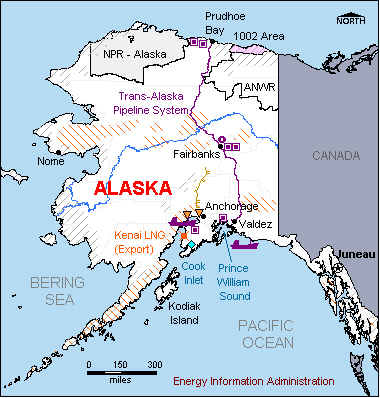
Wednesday, December 22, 2010
Transneft Finishes Crude Trial Runs on ESPO Pipe Spur to China
Platts, December 21, 2010
Russian pipeline operator Transneft's new 300,000 b/d pipeline spur for ESPO crude shipments to China is ready to begin commercial shipments on January 1 following the completion of trial runs Sunday, it said in a statement said late Monday.
Transneft pumped the first trial shipment of crude on November 1, shipping a total of 250,000 mt (61,000 b/d) in November and 300,000 mt in December, the statement said.
The spur travels from Skovorodino, currently the end point of the East Siberia-Pacific Ocean (ESPO) pipeline, to Daqing in China. [See the map below, provided by Reuters - My addition, D.R.]
The main ESPO route was launched in December 2009, and consists of a 600,000 b/d pipeline from oil fields near Taishet in East Siberia to Skovorodino in Russia's Far East, near the border with China.
From there, around 300,000 b/d is currently shipped by rail from Skovorodino to an export terminal at Kozmino on the Pacific coast.
Starting January 1 [2011], Russia's largest oil producer Rosneft is to start to supply China with 15 million mt/year (300,000 b/d) of ESPO crude. The exports are in line with a contract signed in 2009 to supply 300,000 b/d of oil over 20 years to China [i.e., cash-for-oil or loan-for-oil deal -- D.R.]. [Full story]
--Jake Rudnitsky, jake_rudnitsky@platts.com
Similar stories appear in Oilgram News. See more information at http://bit.ly/OilgramNews
For related news, please see Platts Russian Crude Oil Exports feature at http://www.platts.com/newsfeature/2010/espo/index
Сlick on map to enlarge
 Source: UK. Reuters, RPT-UPDATE 3-Russia Prepares to Open Oil Pipeline to China, Sep 27, 2010
(The second phase of the pipeline will involve the construction of a 2,046 km (1,271 miles) section from Skovorodino to the Pacific Ocean terminal at Kozmino, and will replace the rail line -- see map above. It would be commissioned by 2013 or 2014. The first phase of ESPO, running some 2,700 km from Taishet to Skovorodino, was completed in late 2009. See also Takeo Kumagai article in my blog , here. Update 1: In early November 2012, Transneft announced that ESPO-2 has been filled with technological oil and start-up works have started. The filling of the 2,046-km ESPO-2 with oil took about 4 months. The company plans to launch the oil line by the end of the year---please see here. Also, please see another map of the 4,700 km or 2,900 miles ESPO pipeline, the combined ESPO-1 and ESPO-2, here. Update 2: On December 25, 2012, Transneft JSC put into operation the second line of the East Siberia – Pacific Ocean pipeline (ESPO-2) [ ... ]. According to N. Tokarev, the Head of Transneft, “the American market gets about 35 per cent of oil through Koz’mino port, the final destination point of ESPO; Japan gets about 30 per cent; China gets 25-28 per cent. And the rest part goes to Singapore, Malaysia and South Korea”. “I believe such proportions shall be preserved”, he noted. [...]. During the second stage of the project, an oil pipeline sector from Skovorodino to Koz’mino port was built and the capacity of the marine terminal was increased. ESPO-2’s putting into operation will allow increase of the volume of oil dispatched from Koz’mino twice, up to 30 million tons per year [ i.e., 600,000 b/d -- D.R.]. The volume of oil exported from Koz’mino port may reach 15.6-16 million tons [i.e., 312,000-320,000 b/d -- D.R.] in the year 2012, and 21 million tons [i.e., 420,000 b/d -- D.R.] in the year 2013. Considering the route to China (15 million tons of oil per year or 300,000 b/d), 36 million tons [720,000 b/d -- D.R.] are to be pumped in 2013. Handling through Koz’mino may amount 24-25 million tons [i.e., 480,000-500,000 b/d -- D.R.] in 2014, and 30 million tons [i.e., 600,000 b/d -- D.R.] in 2015. N. Tokarev reported that oil delivery to Koz’mino by railway still remain in the near term and shall amount about 3-4 million tons [i.e., 60,000-80,000 b/d --D.R.] per year. [ ... ] Also, N. Tokarev informed that Khabarovsky oil processing plant [i.e., refinery] would get oil from the ESPO system in the year 2014, and Komsomol’sk [-on-Amur] oil processing plant – in the year 2015---please read Transneft website, Dec 25, 2012 (in English). -- D.R.)
Russian pipeline operator Transneft's new 300,000 b/d pipeline spur for ESPO crude shipments to China is ready to begin commercial shipments on January 1 following the completion of trial runs Sunday, it said in a statement said late Monday.
Transneft pumped the first trial shipment of crude on November 1, shipping a total of 250,000 mt (61,000 b/d) in November and 300,000 mt in December, the statement said.
The spur travels from Skovorodino, currently the end point of the East Siberia-Pacific Ocean (ESPO) pipeline, to Daqing in China. [See the map below, provided by Reuters - My addition, D.R.]
The main ESPO route was launched in December 2009, and consists of a 600,000 b/d pipeline from oil fields near Taishet in East Siberia to Skovorodino in Russia's Far East, near the border with China.
From there, around 300,000 b/d is currently shipped by rail from Skovorodino to an export terminal at Kozmino on the Pacific coast.
Starting January 1 [2011], Russia's largest oil producer Rosneft is to start to supply China with 15 million mt/year (300,000 b/d) of ESPO crude. The exports are in line with a contract signed in 2009 to supply 300,000 b/d of oil over 20 years to China [i.e., cash-for-oil or loan-for-oil deal -- D.R.]. [Full story]
--Jake Rudnitsky, jake_rudnitsky@platts.com
Similar stories appear in Oilgram News. See more information at http://bit.ly/OilgramNews
For related news, please see Platts Russian Crude Oil Exports feature at http://www.platts.com/newsfeature/2010/espo/index

(The second phase of the pipeline will involve the construction of a 2,046 km (1,271 miles) section from Skovorodino to the Pacific Ocean terminal at Kozmino, and will replace the rail line -- see map above. It would be commissioned by 2013 or 2014. The first phase of ESPO, running some 2,700 km from Taishet to Skovorodino, was completed in late 2009. See also Takeo Kumagai article in my blog , here. Update 1: In early November 2012, Transneft announced that ESPO-2 has been filled with technological oil and start-up works have started. The filling of the 2,046-km ESPO-2 with oil took about 4 months. The company plans to launch the oil line by the end of the year---please see here. Also, please see another map of the 4,700 km or 2,900 miles ESPO pipeline, the combined ESPO-1 and ESPO-2, here. Update 2: On December 25, 2012, Transneft JSC put into operation the second line of the East Siberia – Pacific Ocean pipeline (ESPO-2) [ ... ]. According to N. Tokarev, the Head of Transneft, “the American market gets about 35 per cent of oil through Koz’mino port, the final destination point of ESPO; Japan gets about 30 per cent; China gets 25-28 per cent. And the rest part goes to Singapore, Malaysia and South Korea”. “I believe such proportions shall be preserved”, he noted. [...]. During the second stage of the project, an oil pipeline sector from Skovorodino to Koz’mino port was built and the capacity of the marine terminal was increased. ESPO-2’s putting into operation will allow increase of the volume of oil dispatched from Koz’mino twice, up to 30 million tons per year [ i.e., 600,000 b/d -- D.R.]. The volume of oil exported from Koz’mino port may reach 15.6-16 million tons [i.e., 312,000-320,000 b/d -- D.R.] in the year 2012, and 21 million tons [i.e., 420,000 b/d -- D.R.] in the year 2013. Considering the route to China (15 million tons of oil per year or 300,000 b/d), 36 million tons [720,000 b/d -- D.R.] are to be pumped in 2013. Handling through Koz’mino may amount 24-25 million tons [i.e., 480,000-500,000 b/d -- D.R.] in 2014, and 30 million tons [i.e., 600,000 b/d -- D.R.] in 2015. N. Tokarev reported that oil delivery to Koz’mino by railway still remain in the near term and shall amount about 3-4 million tons [i.e., 60,000-80,000 b/d --D.R.] per year. [ ... ] Also, N. Tokarev informed that Khabarovsky oil processing plant [i.e., refinery] would get oil from the ESPO system in the year 2014, and Komsomol’sk [-on-Amur] oil processing plant – in the year 2015---please read Transneft website, Dec 25, 2012 (in English). -- D.R.)
Wednesday, December 15, 2010
Russia and Croatia Resurrect Druzhba-Adria Oil Transport Scheme
by Vladimir Socor, The Jamestown Foundation, Vol. 7, Iss. 45, March 8, 2010
Prime Minister Vladimir Putin of Russia and Jadranka Kosor of Croatia discussed the oil transportation scheme known as Druzhba-Adria integration during Kosor’s recent visit to Moscow. The trip marked Croatia’s accession to Gazprom’s South Stream project and opened the way for Russian energy companies’ expansion to the Adriatic coast... .
Druzhba-Adria integration is a decade-old proposal to pump Russian oil volumes from the Druzhba pipeline southward, via Hungarian and Croatian pipelines, to the port of Omisalj on Croatia’s Adriatic coast, for onward shipment by tankers. The proposal entails using Croatia’s transit pipeline, known as Adria Oil Pipeline (Jadranski Naftovod – Janaf), in a reverse mode. Rather than transporting oil from the world market to land-locked Central Europe, as originally intended, the Adria Pipeline would be reverse-used to carry Russian oil for export. More
(Compare this to, D.R.)
Prime Minister Vladimir Putin of Russia and Jadranka Kosor of Croatia discussed the oil transportation scheme known as Druzhba-Adria integration during Kosor’s recent visit to Moscow. The trip marked Croatia’s accession to Gazprom’s South Stream project and opened the way for Russian energy companies’ expansion to the Adriatic coast... .
Druzhba-Adria integration is a decade-old proposal to pump Russian oil volumes from the Druzhba pipeline southward, via Hungarian and Croatian pipelines, to the port of Omisalj on Croatia’s Adriatic coast, for onward shipment by tankers. The proposal entails using Croatia’s transit pipeline, known as Adria Oil Pipeline (Jadranski Naftovod – Janaf), in a reverse mode. Rather than transporting oil from the world market to land-locked Central Europe, as originally intended, the Adria Pipeline would be reverse-used to carry Russian oil for export. More
(Compare this to, D.R.)
Tuesday, December 14, 2010
Japan Sees Russia as 500,000 b/d Oil Supplier by 2015
by Takeo Kumagai, Platts, December 13, 2010
The startup this year of East Siberia-Pacific Ocean (ESPO) shipments from Siberia has positioned Russia to add to its established role of LNG provider and become an increasingly important supplier of crude oil to Japan, which has traditionally depended on the Middle East for most of its imports... .
Japan's total crude imports from Russia could rise to 500,000 b/d by 2015, after the commissioning of the second stage of the 30 million mt/year (600,000 b/d) ESPO pipeline, which will extend the line from Skovorodino in Russia's Far Eastern Amur region to the Pacific port of Kozmino. [See map in this blog, here - D.R.] ...
Over the April-October period of this year, an 85% year-on-year increase in Japan's Russian crude import volumes to 271,000 b/d was recorded, due mainly to the startup in supplies of ESPO... . Read more
The startup this year of East Siberia-Pacific Ocean (ESPO) shipments from Siberia has positioned Russia to add to its established role of LNG provider and become an increasingly important supplier of crude oil to Japan, which has traditionally depended on the Middle East for most of its imports... .
Japan's total crude imports from Russia could rise to 500,000 b/d by 2015, after the commissioning of the second stage of the 30 million mt/year (600,000 b/d) ESPO pipeline, which will extend the line from Skovorodino in Russia's Far Eastern Amur region to the Pacific port of Kozmino. [See map in this blog, here - D.R.] ...
Over the April-October period of this year, an 85% year-on-year increase in Japan's Russian crude import volumes to 271,000 b/d was recorded, due mainly to the startup in supplies of ESPO... . Read more
Friday, December 10, 2010
Iraq's Oil Sector between the Kuwait Crisis & the Post-Ba'thi Era (1990-2006)
Subscribe to:
Posts (Atom)